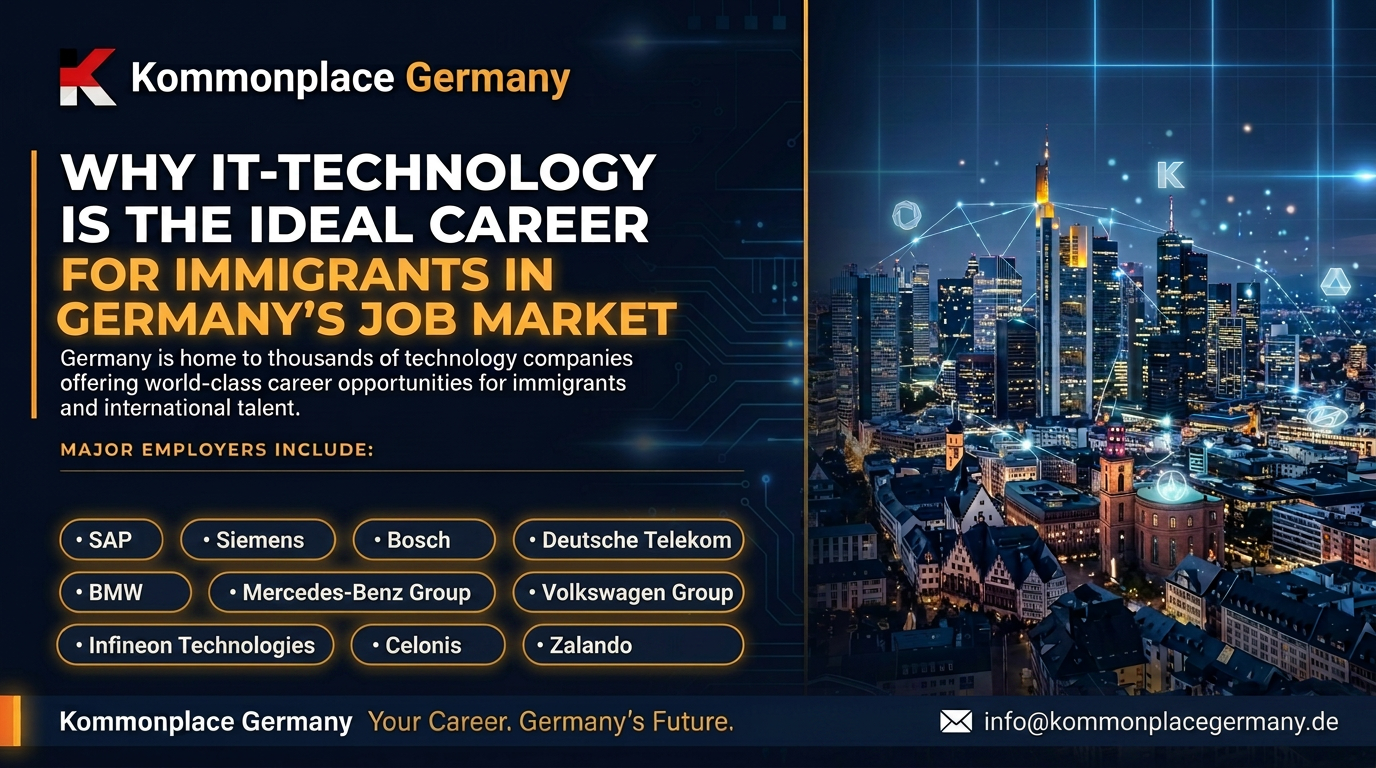
Why IT-Technology Is the Ideal Career for Immigrants in Germany’s Job Market.
By Kommonplace Germany | info@kommonplacegermany.de
Germany is not just open to international IT talent — it is actively searching for it. With over 137,000 unfilled IT positions as of early 2026, the opportunity has never been clearer.
Introduction
Germany stands at a digital crossroads. Its economy — the largest in Europe — is undergoing a sweeping transformation driven by automation, cloud migration, artificial intelligence, and the digitisation of traditional industries. Yet one critical bottleneck threatens to slow this transformation: a severe and growing shortage of skilled IT professionals.
For immigrants and international professionals, this is not just good news — it is a career-defining opportunity. Germany’s technology sector is one of the most welcoming environments for foreign talent, and for very practical reasons: the skills are universal, the work is largely conducted in English, and the demand far outpaces the domestic supply.
This article explores why IT-Technology is the single most strategic career path for immigrants entering Germany’s job market — backed by data, employer insight, and practical guidance.
1. The Numbers Don’t Lie: Germany’s IT Talent Crisis
Germany’s digital ambitions are colliding with a harsh demographic and educational reality. According to the Bitkom Study 2025, Germany faces a shortage of approximately 109,000 IT specialists — and that figure has hovered near crisis levels for several consecutive years.
More strikingly, a 2026 industry report places over 137,000 IT positions unfilled across Germany at the start of the year. The IT sector is growing at over 10% annually, with projections suggesting 700,000 cumulative job openings by the end of 2025–2026.
Year-on-Year Job Opening Trends
| Year | Estimated Unfilled IT Positions | Notes |
|---|---|---|
| 2021 | ~86,000 | Post-pandemic digital acceleration |
| 2022 | ~96,000 | Cloud & AI investment surge |
| 2023 | ~137,000 (record high) | Peak shortage year |
| 2024 | ~109,000 | Slight easing, structural demand remains |
| 2025 | ~115,000 (est.) | Renewed growth in AI and cybersecurity |
| 2026 | 137,000+ | New record; AI, cloud, security boom |
Sources: Bitkom Digital Association Germany, Destatis, virtualassistantplus.com (2026)
Despite a broader economic slowdown — with Germany’s GDP growth barely above 1.2% in 2026 — the IT sector remains not just resilient, but aggressively expanding. This disconnect between general economic caution and tech hiring urgency creates an unusually favourable environment for qualified immigrants.
2. Why Immigrants Have a Competitive Advantage in IT
2.1 The English-Language Factor
One of the most significant barriers immigrants face in German industries is language. Most professional environments require fluent German — in law, medicine, education, and the public sector, German proficiency is non-negotiable.
IT is different.
Germany’s tech ecosystem operates substantially in English. Major tech companies, international startups, and global enterprises based in Germany — SAP, Zalando, Delivery Hero, N26, Celonis — run their engineering teams, code reviews, documentation, stand-up meetings, and internal communications almost entirely in English.
A survey of German tech job postings consistently shows that:
- Over 60% of IT job listings in Berlin explicitly accept English-only applicants
- International companies like Zalando and N26 have declared themselves “English-first” workplaces
- Technical interviews at major employers are routinely conducted in English
For immigrants, this removes the most common employment barrier almost entirely.
2.2 Global Training Meets Local Demand
IT education and training is globally standardised in a way that few other fields are. A software engineer trained in Nigeria, India, Brazil, or Vietnam writes the same Python, deploys to the same AWS infrastructure, and solves the same algorithmic challenges as a developer trained in Munich.
German employers recognise this. According to Terratern’s 2025 guide, companies like Bosch, Siemens, Deutsche Telekom, and SAP are “very aggressive in hiring Indian IT professionals,” reflecting a broader pattern of international tech recruitment that spans talent from across Asia, Africa, Eastern Europe, and Latin America.
2.3 Immigration Policy Actively Supports IT Talent
Germany’s government has taken concrete steps to fast-track IT immigration:
- The Skilled Immigration Act (Fachkräfteeinwanderungsgesetz), expanded in 2023 and 2024, now recognises foreign qualifications from non-EU countries and created the Opportunity Card (Chancenkarte) — a points-based system allowing skilled professionals to enter Germany to job-search without a prior offer
- The EU Blue Card for IT specialists has a lower salary threshold of €43,992/year compared to other professions (€56,400), reflecting the sector’s strategic importance
- The new 2025 Skilled Immigration Act update further simplified visa processes for non-EU IT specialists
As of 2024, 12.4 million employed people with a migration background live and work in Germany (Destatis, 2025). The government’s own forecasts show that without sustained high-migration scenarios, the qualified workforce will shrink dramatically by 2040. IT immigrants are not just welcomed — they are structurally necessary.
2.4 Meritocracy in Code
Perhaps most importantly, IT is a field where output is measurable and talent is visible. A GitHub portfolio, a deployed application, a solved LeetCode problem — these speak louder than a German surname or a German university degree. For immigrants navigating potential bias in hiring, the concrete, demonstrable nature of technical work creates a more level playing field.
3. The Most In-Demand IT Skills in Germany (2025–2026)
Germany’s tech employers are not looking for generalists — they have specific, high-value needs. The following specialisations represent the core of current and projected demand:
⚡ Artificial Intelligence (AI) & Machine Learning
AI has moved from experimental to essential. German manufacturers, logistics firms, financial institutions, and healthcare providers are all deploying AI systems — and need engineers who can build and maintain them. Skills in demand: Python, TensorFlow, PyTorch, LLM fine-tuning, MLOps.
Average Salary: €70,000 – €110,000/year
📊 Data Science & Data Management
Every major German company is attempting to become data-driven. Data scientists, data engineers, and analytics engineers are in enormous demand. Skills: SQL, Python, Spark, dbt, Power BI, Tableau, Snowflake, Azure Data Factory.
Average Salary: €65,000 – €90,000/year Top employers: Zalando, Deutsche Bank, SAP, Amazon
☁️ Cloud Computing
Germany is mid-wave in its cloud migration. Legacy enterprises — banks, manufacturers, insurers — are moving to AWS, Azure, and Google Cloud at scale. Cloud architects and DevOps engineers are among the hardest roles to fill. Skills: AWS, Azure, GCP, Kubernetes, Terraform, Docker.
Average Salary: €70,000 – €100,000/year Top employers: SAP, Siemens, BMW, Volkswagen
🔐 Cybersecurity
As Germany digitises, its attack surface expands. Cybersecurity professionals are critical across government, banking, critical infrastructure, and enterprise. Skills: penetration testing, SIEM, ISO 27001, SOC analysis, network security.
Average Salary: €65,000 – €95,000/year Top employers: BMW, Bosch, Volkswagen, Airbus
💻 Full-Stack Development
The backbone of digital product development. Full-stack developers remain in consistently high demand across e-commerce, fintech, health tech, and enterprise software. Skills: JavaScript, React, Node.js, Python, MongoDB, REST APIs.
Average Salary: €55,000 – €80,000/year Top employers: Zalando, SAP, Delivery Hero, Deutsche Bank
📱 Mobile Development
Germany’s e-commerce sector is expected to reach €111 billion in 2025, growing 12% annually. Mobile-first applications are central to this growth. Skills: Flutter, React Native, Swift, Kotlin.
Average Salary: €55,000 – €80,000/year
4. Major Employers Actively Hiring International IT Talent
🏢 SAP — Walldorf (HQ) | Berlin, Munich, Frankfurt
The world’s largest enterprise software company and Germany’s most iconic tech employer. SAP’s S/4HANA migration wave has created massive, sustained demand for developers, consultants, and cloud engineers. SAP S/4HANA consultants earn €90,000–€150,000 annually, and the company actively sponsors visas for qualified international talent. Indian professionals alone account for 30% of SAP roles in Frankfurt and Munich.
What they’re hiring: Cloud architects, ABAP developers, SAP Basis consultants, AI/ML engineers, data scientists.
⚙️ Siemens — Munich (HQ) | Berlin, Nuremberg, Hamburg
One of Germany’s industrial titans, Siemens is undergoing a profound digital transformation under its “Siemens Xcelerator” platform. The company blends traditional engineering with cutting-edge software development, creating unique roles for IT professionals who want impact at scale.
What they’re hiring: IoT developers, embedded systems engineers, cloud architects, cybersecurity analysts, AI researchers.
🛍️ Zalando — Berlin
Europe’s leading fashion e-commerce platform and one of Germany’s most progressive tech employers. Zalando is explicitly English-first, globally diverse, and consistently ranked among Germany’s best tech workplaces on Glassdoor. With thousands of engineers across Berlin and a product-led culture, Zalando is a top destination for immigrant tech talent.
What they’re hiring: Backend engineers (Go, Python, Scala), data engineers, ML engineers, mobile developers, platform engineers.
🔧 Bosch — Stuttgart (HQ) | Nationwide
Bosch spans automotive, smart home, industrial tech, and energy — and is digitising rapidly across all divisions. With R&D investment exceeding €7 billion annually, Bosch offers IT professionals rare stability combined with genuine innovation.
What they’re hiring: Embedded software engineers, cloud developers, cybersecurity engineers, data scientists.
📡 Deutsche Telekom — Bonn (HQ) | Berlin, Darmstadt
Germany’s telecommunications giant is transforming into a technology platform company. Deutsche Telekom’s T-Systems division is one of Europe’s largest IT service providers and a significant employer of international IT talent.
What they’re hiring: Network engineers, cloud developers, DevSecOps engineers, AI/data engineers.
🚗 BMW & Mercedes-Benz Group — Munich / Stuttgart
Germany’s automotive icons are now, fundamentally, software companies. From autonomous driving systems to digital cockpits, connected mobility to over-the-air updates — both companies need software engineers as urgently as they need mechanical ones.
What they’re hiring: Software-defined vehicle developers, autonomous driving engineers, cybersecurity specialists, full-stack developers.
🌐 Celonis — Munich
A global leader in process mining and execution management, Celonis is one of Germany’s most valuable tech scaleups (valued at $13 billion). It is aggressively global, English-first, and a significant employer of international engineers and data scientists.
What they’re hiring: Backend engineers, data scientists, ML engineers, platform architects.
🛒 Zalando vs. Global Benchmarks (Glassdoor Insights)
According to Glassdoor data, Zalando scores 4.0/5 for employee satisfaction, with specific praise for its inclusive international culture, English-language environment, and career development opportunities — making it consistently one of the top-rated German tech employers for immigrant professionals.
5. Why Practical Experience Matters: German Employers Value More Than Academic Results
One of the most important insights for any immigrant professional — or student — entering the German IT job market is this: German employers are pragmatic. They are not primarily hiring degrees; they are hiring demonstrable capability.
While academic credentials from recognised international universities are respected, German hiring managers in IT consistently prioritise candidates who can show they have solved real problems, worked in real teams, and shipped real software.
What German IT Employers Actually Look For
Successful candidates — whether they are recent graduates or career changers — typically combine their academic background with a portfolio of practical experience. The most valued forms include:
🏭 Internships (Praktikum) A structured internship at a German company provides two things simultaneously: technical experience and cultural integration. Many major employers — SAP, Siemens, Bosch — use their internship programmes as a direct pipeline for permanent hiring.
👨💻 Working Student (Werkstudent) Positions Unique to Germany’s educational culture, Werkstudent roles allow students to work part-time (typically 15–20 hours/week during term, full-time in holidays) at a company while studying. This provides continuous, paid, real-world experience and is one of the most effective pathways to a full-time offer upon graduation.
🔬 Research Assistant Roles (Hiwi/Wissenschaftliche Hilfskraft) Working in a university research group — particularly in AI, data science, or computer science — signals to employers that you can work at the frontier of knowledge, communicate findings, and function in a rigorous, collaborative environment.
🌍 Open-Source Contributions Contributing meaningfully to open-source projects — whether fixing bugs in well-known repositories, building useful libraries, or maintaining a project — demonstrates initiative, code quality, and the ability to collaborate with distributed, international teams. German employers in software development increasingly review candidates’ GitHub contribution history as part of their evaluation.
🛠️ Personal Software Projects Building and deploying your own applications — a web app, a mobile tool, a data pipeline — shows employers that you can take an idea from concept to reality independently. Projects do not need to be groundbreaking; they need to be finished, documented, and deployed.
⚔️ Hackathons Participation in hackathons — particularly those organised by major companies like Zalando, SAP, or Siemens, or through platforms like Devpost — demonstrates the ability to work under pressure, collaborate rapidly, and produce working prototypes. German employers value this highly as evidence of practical problem-solving.
📁 GitHub Portfolios A well-maintained GitHub profile is increasingly considered as important as a CV in the German IT hiring process. Recruiters and technical hiring managers routinely review commit history, code quality, documentation standards, and project diversity before deciding whether to invite a candidate to interview.
🎓 Industry Certifications While not a substitute for practical experience, certifications from AWS, Google Cloud, Microsoft Azure, Cisco, CompTIA, or Certified Data Professional bodies serve as credible, internationally recognised signals of competency. For immigrants whose domestic qualifications may be less familiar to German employers, certifications from globally recognised bodies can bridge the credibility gap effectively.
The Werkstudent Pathway: A Special Note for International Students
For immigrants currently studying in Germany, the Werkstudent model is arguably the single most important career tool available. It provides:
- A salary (typically €12–€18/hour)
- Real-world German work experience
- A professional reference from a recognised employer
- A high probability of a full-time offer post-graduation
- Integration into a professional network in Germany
Students at universities in Munich, Berlin, Hamburg, and Stuttgart — where most major tech employers are headquartered or have significant offices — are particularly well-positioned to access these opportunities.
6. Germany’s Tech Hubs: Where the Opportunities Are
Germany’s IT job market is distributed across multiple world-class cities, each with a distinct character:
| City | Tech Character | Key Employers |
|---|---|---|
| Berlin | Startup capital, e-commerce, fintech, English-dominant | Zalando, N26, Trade Republic, HelloFresh |
| Munich | Enterprise tech, automotive, AI research | SAP, BMW, Siemens, Celonis, MAN |
| Frankfurt | Fintech, banking tech, cloud infrastructure | Deutsche Bank, DWS, AWS |
| Hamburg | E-commerce, logistics tech, media | Airbus, XING, Otto Group |
| Stuttgart | Automotive software, IoT, industrial tech | Bosch, Mercedes-Benz, Porsche |
| Cologne/Düsseldorf | Telecoms, retail tech, consulting | Deutsche Telekom, Vodafone |
7. Salary Benchmarks: What IT Professionals Earn in Germany
Germany offers some of Europe’s most competitive IT salaries, particularly at senior levels:
| Role | Junior (0–2 yrs) | Mid (3–5 yrs) | Senior (6+ yrs) |
|---|---|---|---|
| Software Developer | €45,000–€55,000 | €60,000–€75,000 | €80,000–€100,000 |
| Data Scientist | €50,000–€65,000 | €70,000–€85,000 | €90,000–€120,000 |
| Cloud / DevOps Engineer | €50,000–€65,000 | €70,000–€90,000 | €95,000–€120,000 |
| Cybersecurity Analyst | €48,000–€62,000 | €65,000–€80,000 | €85,000–€110,000 |
| AI / ML Engineer | €55,000–€70,000 | €75,000–€95,000 | €100,000–€130,000 |
| SAP Consultant | €60,000–€80,000 | €85,000–€110,000 | €120,000–€150,000 |
Sources: Glassdoor Germany, Terratern, GermanTechJobs Report 2025
8. Getting Started: Your Action Plan
If you are an immigrant considering or actively pursuing an IT career in Germany, here is a practical starting framework:
- Assess your current skills — Identify where you sit among the in-demand specialisations (AI, Cloud, Full-Stack, Cybersecurity, Data)
- Build your GitHub portfolio — Start or improve your public repositories today; this is your most powerful job application tool
- Pursue one targeted certification — AWS Certified Developer, Google Cloud Professional, or Microsoft Azure Fundamentals are all globally respected entry points
- Apply for Werkstudent roles (if studying) — Even a semester of professional experience dramatically improves your hiring prospects
- Target English-first companies first — Zalando, Celonis, N26, and international divisions of SAP and Siemens are ideal entry points
- Use the Opportunity Card (Chancenkarte) if you do not yet have a German job offer — it allows you to enter Germany and job-search legally for up to one year
- Register with German tech job platforms — GermanTechJobs.de, Honeypot, Stepstone, and LinkedIn Germany are the primary sourcing channels
Conclusion
Germany’s IT talent shortage is not a temporary blip — it is a structural condition driven by an ageing population, accelerating digitalisation, and a domestic education system that cannot produce enough computer science graduates fast enough. The Bitkom Association, the Federal Government, and Germany’s largest employers have all reached the same conclusion: international IT talent is essential to Germany’s economic future.
For immigrants, this is a rare alignment of need and opportunity. IT skills are portable. The work is conducted in English. The salaries are competitive. The immigration pathways are improving. And the demand will only grow.
The question is not whether Germany needs you. It does. The question is whether you are ready to take the opportunity.
Ready to start your IT career journey in Germany? Visit Kommonplace Germany — your trusted platform for verified guidance, practical resources, and community support.
📧 info@kommonplacegermany.de 🌐 One Platform. Every Step. Real Support.
Sources: Bitkom Digital Association Germany (2025), Destatis Federal Statistical Office, Terratern Tech Jobs Guide 2025, GermanTechJobs IT Market Report 2025, virtualassistantplus.com (2026), accessfuture.net Germany Job Market 2025, IAB-Forum Migration & Labour Market Report (2025), Glassdoor Germany.