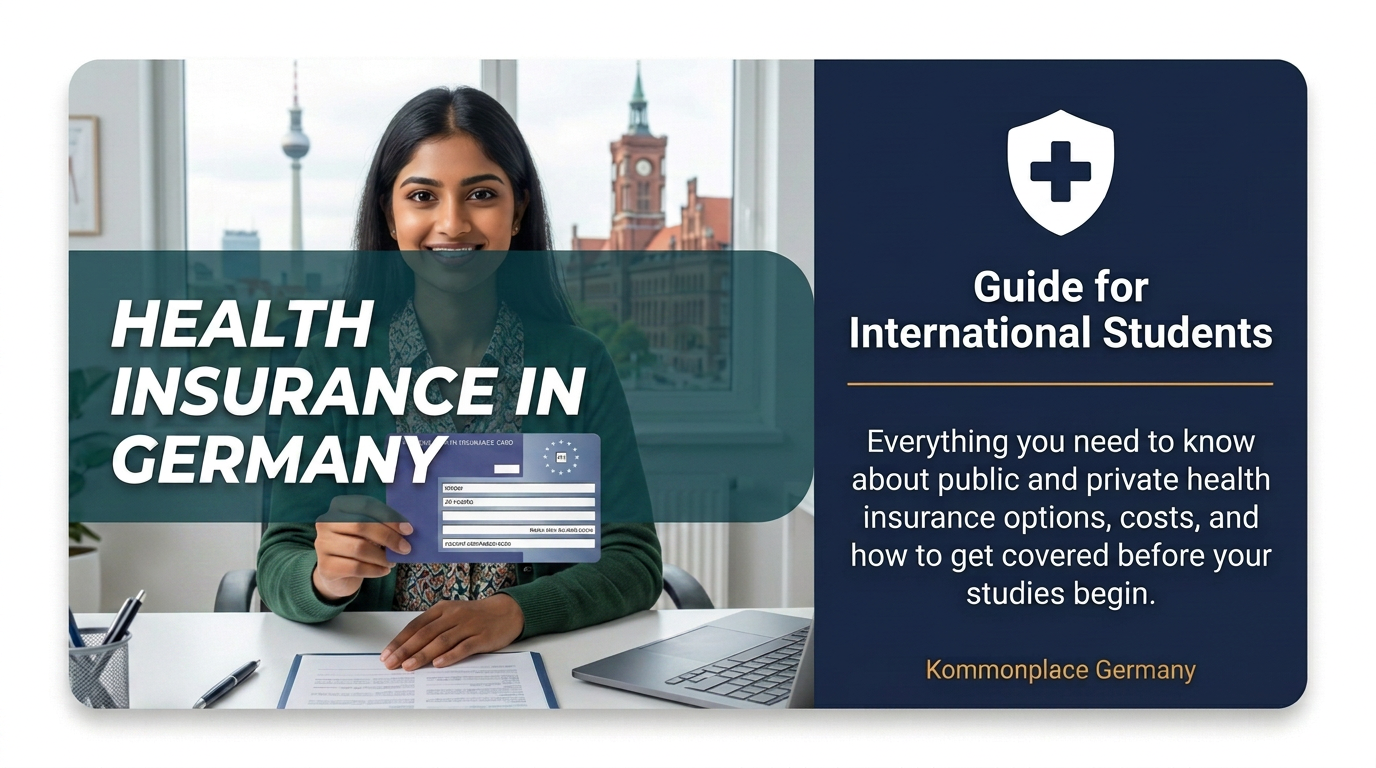
Health Insurance for International Students in Germany
Published on the Kommonplace Directory | Category: Insurance Guide Germany
Quick Summary: Health insurance is mandatory for all students enrolled at a German university. Without proof of health coverage, you cannot complete your university enrolment (Immatrikulation). This guide explains the types of insurance available, how to choose the right one, costs, and the best providers for international students.
Table of Contents
- Why Health Insurance Is Mandatory in Germany
- Types of Health Insurance in Germany
- Public vs. Private Health Insurance: Key Differences
- Who Qualifies for Public Health Insurance?
- How Much Does Student Health Insurance Cost?
- Top Health Insurance Providers for Students
- How to Get Health Insurance Before Arriving
- Step-by-Step: Getting Covered
- What Is and Isn’t Covered
- Exemptions from Public Insurance
- Health Insurance & Your Blocked Account
- Frequently Asked Questions
- Related Resources on Kommonplace
- References & Sources
Why Health Insurance Is Mandatory in Germany
Germany has one of the best healthcare systems in the world — and access to it is non-negotiable for students. When you enrol at a German university, you must present proof of health insurance (Krankenversicherungsnachweis). Without it, your enrolment will be rejected.
The legal basis is the Social Security Code (SGB V), which mandates that all residents in Germany — including international students — have health coverage.
🔗 Browse verified Insurance providers in our Germany Directory to compare student plans side by side.
Health insurance also feeds into your student visa application: German embassies may ask for proof of planned coverage as part of the financial sufficiency documentation.
Types of Health Insurance in Germany
There are two main categories of health insurance in Germany:
1. Statutory/Public Health Insurance (Gesetzliche Krankenversicherung — GKV)
The standard system used by most students. Premiums are standardised and regulated by the government.
2. Private Health Insurance (Private Krankenversicherung — PKV)
An alternative for students who do not qualify for public insurance or who choose to opt out. Premiums vary based on age, health status, and coverage level.
3. Travel/Incoming Insurance (Short-term)
Some students use travel insurance temporarily for example, while waiting for their public insurance to activate. This is not accepted for university enrolment.
Public vs. Private Health Insurance: Key Differences
| Feature | Public (GKV) | Private (PKV) |
|---|---|---|
| Monthly Cost (2024/25) | ~€110–€120/month | ~€30–€160/month (varies widely) |
| Coverage | Comprehensive, standardised | Often more extensive |
| Family Coverage | Free for dependants | Not included |
| Age Limit | Up to 30 years (or 14 semesters) | No age restriction |
| Pre-existing Conditions | Always covered | May affect premiums |
| University Acceptance | ✅ Always accepted | ✅ Accepted (with exemption letter) |
| Switching | Possible annually | Harder to switch back to public |
| Best For | Most international students | Older students, specific situations |
Who Qualifies for Public Health Insurance?
You qualify for subsidised student public health insurance if you are:
- Under 30 years old OR within your first 14 semesters of study
- Enrolled at a state-recognised German university
- Not employed more than 20 hours/week during term time
- Not earning more than €505/month regularly
If you are over 30 or beyond 14 semesters, you will need to apply for voluntary public insurance (higher premium) or private insurance.
How Much Does Student Health Insurance Cost?
Public Health Insurance (GKV) — 2024/2025 Rates
| Provider | Monthly Premium | Additional Contribution |
|---|---|---|
| TK (Techniker Krankenkasse) | ~€111.90 | ~1.2% |
| AOK | ~€111.90 | Varies by region |
| Barmer | ~€111.90 | ~1.5% |
| DAK-Gesundheit | ~€111.90 | ~1.7% |
| Expatrio Health | From ~€111.90 | Integrated with blocked account |
The base rate is set by the government. Providers compete on the additional contribution (Zusatzbeitrag) and services offered.
Top Health Insurance Providers for Students
TK — Techniker Krankenkasse
Germany’s largest public health insurer. Excellent English-language support, a strong student-facing app, and widely recognised across all universities.
- Website: tk.de
- Best for: Students who want reliable public coverage with great digital services
AOK
Regional provider with offices across Germany. Strong for students who want in-person support.
- Website: aok.de
- Best for: Students based in specific German states
Barmer
Another major public insurer with a solid English app and student orientation services.
- Website: barmer.de
- Best for: Students wanting comprehensive digital management
Expatrio Health
Designed specifically for international students. Can be bundled directly with your Expatrio blocked account for a seamless setup before arrival.
- Website: expatrio.com
- Best for: Students who want everything set up before landing in Germany
Care Concept (Private)
A popular private insurance option for students who don’t qualify for public GKV — particularly those over 30 or studying a preparatory course (Studienkolleg).
- Website: care-concept.de
- Best for: Students who do not qualify for GKV
How to Get Health Insurance Before Arriving
Getting insured before you land in Germany is possible and recommended. Here’s why:
- You may need proof of insurance for your visa application
- Your university enrolment requires immediate proof
- Expatrio and some providers offer pre-arrival activation
🔗 See also: Blocked Account Guide — Expatrio & Fintiba — Expatrio offers a combined blocked account + health insurance bundle.
Step-by-Step: Getting Covered
Step 1 — Determine Your Eligibility
Check if you qualify for public (GKV) or need private (PKV) insurance based on your age and semester count.
Step 2 — Choose a Provider
Compare providers based on monthly cost, English support, and digital services. See the table above.
Step 3 — Register Online
Most providers allow online registration. You will need your passport, university admission letter, and German address (or intended address).
Step 4 — Receive Your Insurance Certificate
The provider issues a Versicherungsbescheinigung your official proof of insurance for university enrolment.
Step 5 — Submit to Your University
Bring or upload the certificate to your university’s student office (Studentensekretariat) to complete enrolment.
Step 6 — Receive Your Insurance Card
Your physical insurance card (Versichertenkarte) arrives within 2–4 weeks. Use this at any doctor or pharmacy in Germany.
What Is and Isn’t Covered
| Covered ✅ | Not Covered ❌ |
|---|---|
| Doctor visits (GP and specialists) | Dental (basic coverage only) |
| Hospital stays | Private hospital rooms |
| Prescription medications | Glasses/contact lenses (usually) |
| Mental health therapy | Cosmetic procedures |
| Emergency treatment | Alternative medicine (usually) |
| Preventive check-ups | Treatment abroad (limited) |
| Maternity care |
Exemptions from Public Insurance
Students who are already covered by a foreign insurance may apply for an exemption from public insurance (Befreiung von der Versicherungspflicht). This is done at your chosen GKV provider. Once exempted, you must provide proof of equivalent private coverage.
⚠️ Important: Exemption is permanent for your current degree. You cannot switch back to public insurance mid-degree.
Health Insurance & Your Blocked Account
Your monthly blocked account payout of €992 is designed to cover all living expenses — including health insurance. The government calculates this assuming approximately €110–€120 of that goes toward health insurance each month.
🔗 Related: Blocked Account Guide — Expatrio vs. Fintiba 🔗 Related: Cost of Living in Germany for Students
Frequently Asked Questions
Q: Can I use my home country’s health insurance in Germany? In most cases, no — or only temporarily. EU students with a European Health Insurance Card (EHIC) have some coverage, but it is not sufficient for enrolment. Non-EU students must get German health insurance.
Q: When should I get health insurance? Ideally before arriving. Some providers like Expatrio allow pre-arrival setup. At the latest, you must have it on your first day of enrolment.
Q: What if I work part-time in Germany? If you earn more than €505/month or work more than 20 hours/week during term time, your status may shift from student to employee insurance meaning higher contributions.
Q: Is dental covered? Basic dental (fillings, extractions) is covered. Advanced dental work (crowns, orthodontics) is partially covered at around 60–70%, with the rest paid by you.
Q: Can I change insurance providers? Yes, with public insurance you can switch providers with a notice period (usually 2 months). Switching from private back to public mid-degree is generally not possible.
Related Resources on Kommonplace
🔗 Insurance Guide Germany — Full Directory 🔗 Blocked Accounts in Germany — Expatrio vs. Fintiba 🔗 Cost of Living in Germany for Students 🔗 How to Apply for a German Student Visa 🔗 Opening a German Bank Account 🔗 Find Universities in Germany
References & Sources
- German Federal Ministry of Health — GKV Overview: bundesgesundheitsministerium.de
- TK Techniker Krankenkasse for Students: tk.de/en
- DAAD — Health Insurance in Germany: daad.de
- Make it in Germany — Health Insurance: make-it-in-germany.com
- Expatrio Health: expatrio.com
- Care Concept Private Insurance: care-concept.de
- GKV Spitzenverband (Central Association): gkv-spitzenverband.de
This article is part of the Kommonplace Germany Directory — your all-in-one platform for living, studying, and thriving in Germany. For Internationals. By Experience.
Last updated: July 2026