
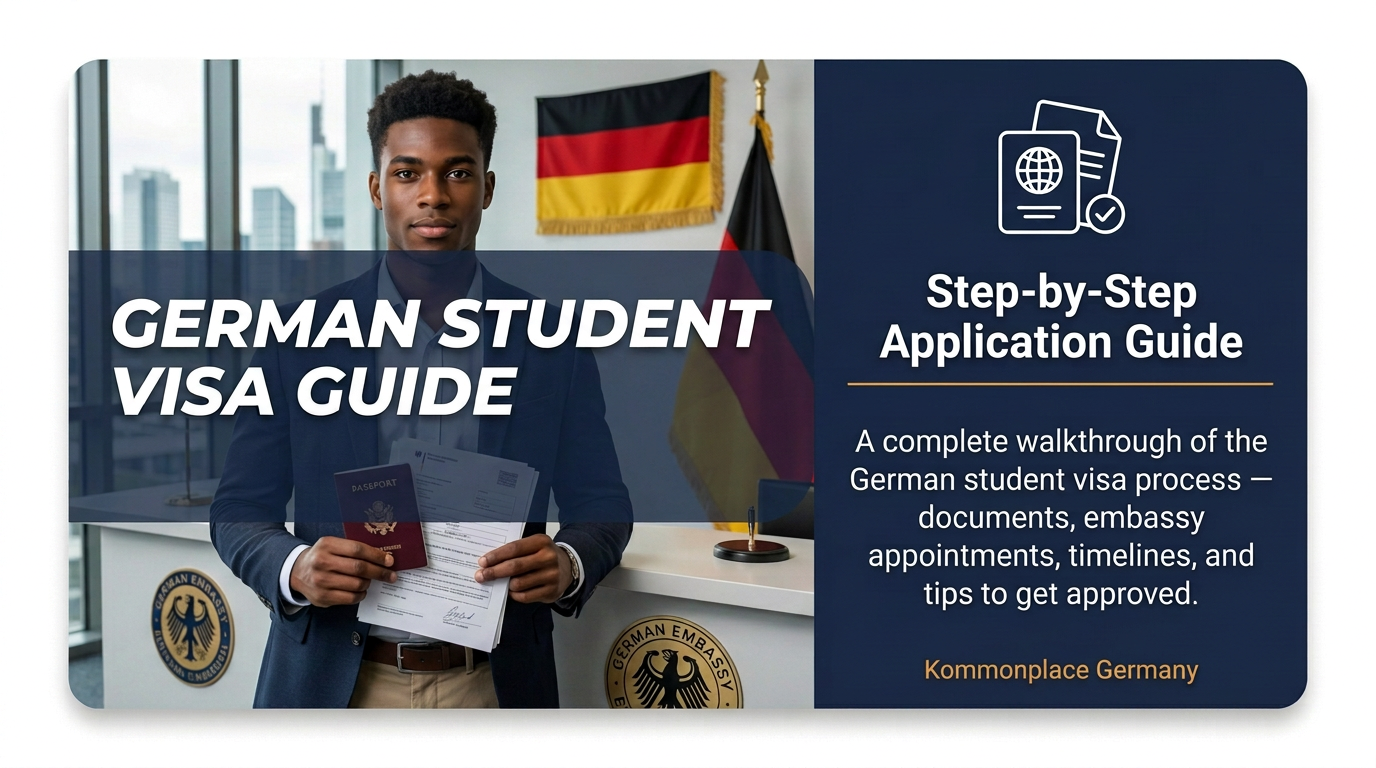
How to Apply for a German Student Visa
Published on the Kommonplace Germany | Category: Visas & Legal Info Germany
Quick Summary: Most non-EU international students need a National Visa (Type D) to study in Germany. This guide walks you through every step of the application — from required documents and embassy appointments to processing times and what to do after you arrive.
Table of Contents
- Do You Need a Student Visa for Germany?
- Types of German Student Visas
- Complete Document Checklist
- Step-by-Step Application Process
- How to Book an Embassy Appointment
- Financial Requirements: Blocked Account & More
- Processing Times by Country
- After Arrival: Residence Permit (Aufenthaltserlaubnis)
- Common Reasons for Visa Rejection
- Tips for a Successful Application
- Frequently Asked Questions
- Related Resources on Kommonplace
- References & Sources
Do You Need a Student Visa for Germany?
Your visa requirement depends on your nationality:
| Nationality | Requirement |
|---|---|
| EU/EEA citizens | No visa needed — free movement applies |
| Swiss citizens | No visa needed |
| USA, Canada, Australia, Japan, South Korea, UK, Israel, New Zealand | Can enter without a visa and apply for a residence permit in Germany |
| All other non-EU nationals | Must apply for a National Visa (Type D) before entering Germany |
⚠️ Even if your country is visa-exempt for entry, you will still need a residence permit once in Germany for stays longer than 90 days.
🔗 See the full Visas & Legal Info Directory on Kommonplace Germany
Types of German Student Visas
1. Student Visa (Studentenvisum) — National Visa Type D
The standard visa for students admitted to a full degree programme at a German university. Valid for the duration of your studies.
2. Student Applicant Visa (Visum zur Studienbewerbung)
For students who have NOT yet received university admission. Allows you to travel to Germany to apply to universities in person. Valid for 6 months, non-renewable.
3. Language Course Visa (Sprachkursvisum)
For students attending a preparatory German language course (Studienkolleg or Sprachkurs). Valid for up to 1 year.
4. Preparatory Course Visa (Studienkolleg-Visum)
For students attending a Studienkolleg to qualify for German university entry.
Complete Document Checklist
Prepare all documents before your embassy appointment. Requirements can vary slightly by country, so always check your local German Embassy website.
Core Documents (All Applicants)
| Document | Details |
|---|---|
| ✅ Completed Visa Application Form | Available from your German Embassy website |
| ✅ Valid Passport | Must be valid at least 6 months beyond intended stay; 2 blank pages |
| ✅ Biometric Photos | 2 recent passport-size photos (35mm x 45mm, biometric standard) |
| ✅ University Admission Letter | Official letter of admission (Zulassungsbescheid) from a German university |
| ✅ Proof of Financial Resources | Blocked account confirmation (€11,904 minimum) OR scholarship letter OR sponsorship declaration |
| ✅ Health Insurance Proof | Certificate from a German public or approved private insurer |
| ✅ CV / Curriculum Vitae | Academic and professional background |
| ✅ Academic Transcripts | Certified copies of all previous degrees and certificates |
| ✅ Language Certificates | German (if required by programme) and/or English (IELTS/TOEFL/equivalent) |
| ✅ Motivation Letter | Why you want to study in Germany, at this university |
| ✅ Visa Fee Payment | €75 (standard); €37.50 for under-18s |
Additional Documents (Where Applicable)
| Document | When Needed |
|---|---|
| Translation of Documents | If originals are not in German or English |
| Scholarship Letter | If using scholarship as financial proof |
| Sponsorship Declaration (Verpflichtungserklärung) | If a German resident is sponsoring you |
| Previous Visa / Residence Permit | If you have studied in Germany before |
Step-by-Step Application Process
Step 1 — Receive University Admission
Apply to German universities and receive an official admission letter (Zulassungsbescheid). Without this, you cannot apply for the standard student visa.
🔗 Find universities accepting English-taught bachelor applications — Kommonplace University Directory
Find universities accepting English-taught masters applications — Kommonplace University
Step 2 — Open a Blocked Account
Prove your financial resources by opening a blocked account with a minimum deposit of €11,904.
Step 3 — Get Health Insurance
Obtain proof of German public or approved private health insurance.
Step 4 — Gather All Documents
Prepare your complete document package (see checklist above). Get translations certified where required.
Step 5 — Book Embassy Appointment
Contact the German Embassy or Consulate in your home country to book a visa appointment. Appointments can fill up fast — book 3–6 months in advance.
Step 6 — Attend Your Appointment
Attend your embassy appointment with all original documents and copies. The consular officer may ask questions about your study plans.
Step 7 — Pay Visa Fee
Pay the visa fee of €75 at the appointment (or as required by your embassy).
Step 8 — Wait for Processing
Processing typically takes 4–12 weeks depending on your country and embassy workload.
Step 9 — Collect Your Visa
Once approved, collect your passport with the visa sticker (or it is returned to you by post).
Step 10 — Travel to Germany & Register
After arriving, register your address at the local registration office (Einwohnermeldeamt) within 2 weeks and apply for your residence permit (Aufenthaltserlaubnis) at the immigration office (Ausländerbehörde).
How to Book an Embassy Appointment
- Visit the official website of the German Embassy or Consulate in your country
- Navigate to “Visa” → “Student Visa” or “National Visa”
- Use the online appointment booking system (often called Terminbuchung)
- Some embassies use third-party platforms like VFS Global or TLS Contact
- Book as early as possible — popular embassies in countries like India, China, and Nigeria often have waitlists of several months
🔗 Find your local German Embassy: auswaertiges-amt.de/en/embassy-finder
Financial Requirements: Blocked Account & More
Germany requires proof that you can support yourself financially during your studies. The main options are:
| Option | Details |
|---|---|
| Blocked Account | Deposit €11,904 with Expatrio or Fintiba — most widely accepted |
| Scholarship Letter | Official letter from DAAD, Erasmus+, or other recognised scholarship body |
| Sponsorship Declaration | A German resident signs a Verpflichtungserklärung at the local immigration office |
| Parental Financial Guarantee | Bank statements + income proof from parents (acceptance varies by embassy) |
Processing Times by Country
| Region / Country | Average Processing Time |
|---|---|
| Western Europe | 4–6 weeks |
| USA & Canada | 4–8 weeks |
| India | 6–12 weeks |
| China | 6–10 weeks |
| Nigeria | 8–16 weeks |
| Brazil | 6–10 weeks |
| Middle East | 6–10 weeks |
| Southeast Asia | 4–8 weeks |
These are estimates only. Always apply well in advance of your programme start date.
After Arrival: Residence Permit (Aufenthaltserlaubnis)
Your student visa is typically valid for 3 months. Once in Germany, you must:
- Register your address (Anmeldung) at the local registry office (Einwohnermeldeamt) within 2 weeks of arrival
- Enrol at your university — present health insurance, blocked account, and admission letter
- Apply for a Residence Permit at the local immigration office (Ausländerbehörde). This replaces your visa and is valid for the duration of your studies
- Open a German bank account to receive your monthly blocked account payouts
🔗 Guide to Opening a German Bank Account 🔗 Cost of Living in Germany — What to Budget For
Common Reasons for Visa Rejection
- Incomplete documentation
- Insufficient financial proof
- Unconvincing motivation letter
- Language certificate does not meet programme requirements
- Gaps in academic history not explained
- Embassy not satisfied with ties to home country
- Previous visa violations
Tips for a Successful Application
- Apply early — don’t wait for your admission letter to start preparing documents
- Book your embassy appointment as soon as possible — slots fill up months in advance
- Double-check document requirements with your specific German embassy — they vary
- Have all documents translated by a certified translator if not in German or English
- Write a strong motivation letter — explain clearly why Germany, why this university, and your career plan
- Open your blocked account early — Expatrio and Fintiba can take 1–2 weeks plus transfer time
- Keep digital copies of all documents submitted
Frequently Asked Questions
Q: Can I work in Germany on a student visa? Yes. International students can work up to 120 full days or 240 half days per year without a work permit.
Q: Can I bring my family to Germany while I study? Yes, under certain conditions. Your spouse/partner may be eligible for a dependent visa (Familiennachzug), but must also prove financial resources.
Q: What if my visa is rejected? You can appeal the decision or reapply with stronger documentation. Your blocked account deposit is refunded in full if you choose to close the account.
Q: Do I need a visa if I’m studying online from abroad? No — you only need a visa if you are physically residing in Germany for your studies.
Q: Can I extend my student visa in Germany? Yes, through your local Ausländerbehörde. Apply for an extension at least 6 weeks before your current permit expires.
Related Resources on Kommonplace
🔗 Visas & Legal Info Germany — Full Directory 🔗 Blocked Accounts — Expatrio vs. Fintiba 🔗 Health Insurance for International Students 🔗 Cost of Living in Germany for Students 🔗 Opening a German Bank Account 🔗 Find Universities in Germany
References & Sources
- German Foreign Office — Visa Information: auswaertiges-amt.de
- Make it in Germany — Student Visa: make-it-in-germany.com
- DAAD — Entry and Residence: daad.de
- German Embassy Finder: auswaertiges-amt.de/en/embassy-finder
- Federal Office for Migration and Refugees (BAMF): bamf.de
- Study in Germany Official Portal: study-in-germany.de
- VFS Global — German Visa Services: vfsglobal.com
This article is part of the Kommonplace Germany Directory — your all-in-one platform for living, studying, and thriving in Germany. For Internationals. By Experience.
Last updated: July 2026
One thought on “How to Apply for a German Student Visa”