Why DAAD Scholarships and Erasmus+ Exchange in Germany Are the Best Opportunities in 2026
Published on Kommonplace Germany | Category: Scholarships & Funding Germany
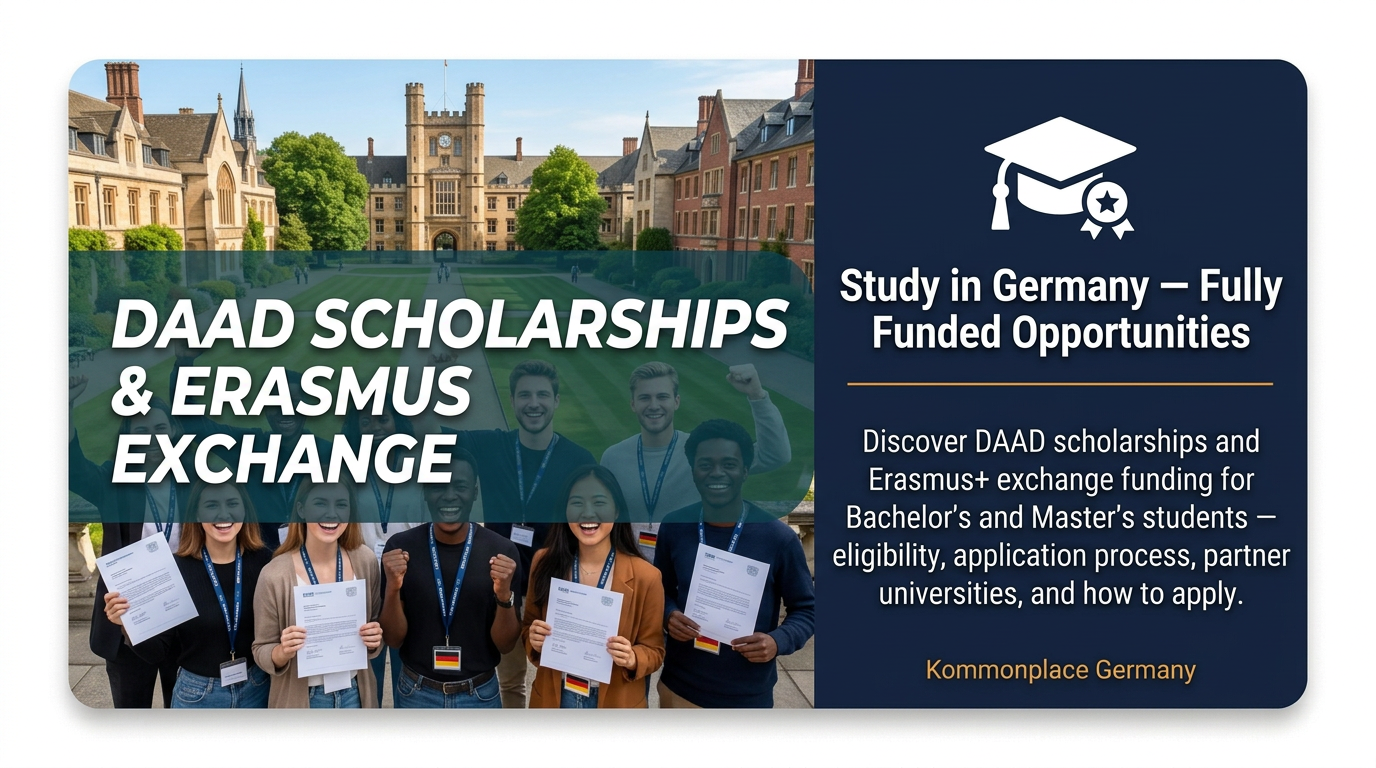
DAAD Scholarships and Erasmus Exchange in Germany offers some of the world’s most prestigious scholarship and exchange programmes for international students. The DAAD (Deutscher Akademischer Austauschdienst) is Germany’s largest scholarship organisation funding thousands of students annually for Bachelor’s, Master’s, PhD, and research programmes. The Erasmus+ Exchange Programme funds European and partner-country students for semester exchanges at German universities. This guide covers both programmes in full — how they work, eligibility, funded courses, partner universities, and how to apply.
Table of Contents
- What Is DAAD?
- How DAAD Works — Funding & Structure
- DAAD Scholarship Types
- DAAD Eligibility & General Requirements
- How to Apply for a DAAD Scholarship
- 20 DAAD-Funded Courses — Bachelor’s & Master’s
- What Is the Erasmus+ Exchange Programme?
- How Erasmus+ Works in Germany
- Erasmus+ Funding — What It Covers
- 15 Courses in Germany Benefiting from Erasmus+ Exchange
- Erasmus+ Partner Universities in Germany
- DAAD vs. Erasmus+: Key Differences
- Tips for a Successful Scholarship Application
- Frequently Asked Questions
- Related Resources on Kommonplace Germany
- References & Sources
What Is DAAD?
The DAAD (Deutscher Akademischer Austauschdienst), translated as the German Academic Exchange Service, is the world’s largest funding organisation dedicated to international academic exchange and one of the leading providers of DAAD Scholarships and Erasmus+ Exchange in Germany. Founded in 1925 and headquartered in Bonn, Germany, DAAD operates as a registered association of German universities and student unions. Its mission is to promote international education, academic cooperation, research collaboration, and cultural exchange by supporting students, graduates, researchers, and university staff from around the world.
For thousands of international students, DAAD Scholarships and Erasmus+ Exchange in Germany provide an affordable pathway to study, conduct research, or complete academic exchanges at top-ranked German universities. Through a wide range of scholarship programmes, research grants, and mobility initiatives, DAAD partners with universities, governments, and international organisations to strengthen global education and innovation.
Whether you are planning your DAAD application 2026 for a Bachelor’s, Master’s, PhD, or research programme, understanding how DAAD Scholarships and Erasmus+ Exchange in Germany work is the first step toward securing financial support. Every year, thousands of students benefit from DAAD Scholarships and Erasmus+ Exchange in Germany, making Germany one of the most attractive study destinations for international students seeking world-class education, career opportunities, and internationally recognized qualifications. The best time to start your DAAD Application 2026, study in Germany scholarships, fully funded scholarships in Germany, and Germany exchange programs is right now.
Key Facts About DAAD
| Fact | Detail |
|---|---|
| Founded | 1925 |
| Headquarters | Bonn, Germany |
| Annual budget | Over €700 million |
| Students funded annually | ~100,000 individuals from 137+ countries |
| Offices worldwide | 72 offices and information centres globally |
| Funded by | German Federal Foreign Office, Federal Ministry of Education and Research (BMBF), EU, and others |
| Programmes offered | 100+ scholarship and funding programmes |
| Official website | daad.de |
DAAD funds both:
- Incoming students — international students coming to study in Germany
- Outgoing students — German students going abroad
For international students, DAAD is one of the most accessible and prestigious routes to study in Germany — often covering full tuition (where applicable), monthly living stipends, health insurance, and travel costs.
🔗 Browse all scholarship opportunities in the Kommonplace Germany Scholarships Directory
How DAAD Scholarships and Erasmus+ Exchange in Germany Works — Funding & Structure
DAAD operates through a network of funding programmes each designed for different academic levels, countries of origin, subject areas, and duration of stay.
If you are planning to study abroad, understanding the differences between DAAD Scholarships and Erasmus+ Exchange in Germany is essential. Every year, thousands of international students apply for DAAD Scholarships Germany and Erasmus+ Exchange Germany because both programs provide outstanding financial support and access to world-class universities.
The DAAD Application 2026 process allows eligible students from many countries to apply for fully funded master’s, PhD, and research scholarships. Meanwhile, the Erasmus+ Exchange Program is designed mainly for students already enrolled at a participating university who want to study in Germany for one or two semesters.
Choosing between DAAD Scholarships and Erasmus+ Exchange in Germany depends on your academic goals. If you want a full degree in Germany, the DAAD Scholarship 2026 is often the better choice. If you prefer short-term international experience while remaining enrolled at your home university, Erasmus+ Exchange Germany offers excellent mobility opportunities.
Both DAAD Scholarships Germany and Erasmus+ Germany help students reduce tuition costs, gain international experience, build professional networks, and improve career opportunities after graduation.
Scholarships and Erasmus+ Exchange in Germany provide financial support through a wide range of funding programmes designed for different academic levels, countries of origin, fields of study, and study durations. Whether you are preparing your DAAD application 2026 for a Bachelor’s, Master’s, PhD, or research programme, these funding opportunities help reduce education costs while giving students access to Germany’s world-class universities and international exchange programmes.
The DAAD Funding Model
DAAD Scholarship Application
        │
        ├── Direct to DAAD (daad.de portal)
        │
        ├── Via German University (embedded scholarships)
        │
        └── Via Home Country DAAD Office / Embassy
The DAAD funding model is one of the most comprehensive international scholarship systems available for students who want to study in Germany. Through DAAD Scholarships and Erasmus+ Exchange in Germany, thousands of international students receive financial support every year to pursue bachelor’s, master’s, doctoral, and research programmes at leading German universities. The DAAD funding model is designed to remove financial barriers and make Germany one of the most attractive destinations for higher education.
For students preparing their DAAD Application 2026, understanding the DAAD funding model is essential before selecting a university or degree programme. Unlike traditional scholarships that only cover tuition fees, DAAD Scholarships Germany often provide a complete financial package, allowing students to focus on their academic and professional development while studying in Germany.
One of the major advantages of DAAD Scholarships and Erasmus+ Exchange in Germany is that both funding programmes support academic excellence, international collaboration, and student mobility. While the DAAD funding model primarily supports full-degree programmes, postgraduate studies, doctoral research, and scientific projects, the Erasmus+ Exchange Programme focuses on semester-based study abroad opportunities through Erasmus Exchange Germany Partner Universities. Together, DAAD Scholarships and Erasmus+ Exchange in Germany create outstanding opportunities for students seeking internationally recognised qualifications and global career prospects.
What Does the DAAD Funding Model Cover?
Depending on the scholarship programme, the DAAD funding model may include:
- Monthly scholarship payments to cover living expenses.
- Partial or full tuition support where applicable.
- International travel allowances.
- Comprehensive health, accident, and personal liability insurance.
- Research grants and academic project funding.
- German language preparation courses before study begins.
- Family and childcare allowances for eligible students.
- Additional funding for conferences, fieldwork, and research activities.
These benefits make DAAD Scholarships Germany one of the most competitive Study in Germany scholarships available to international students.
How the DAAD Funding Model Supports International Students
The DAAD funding model is more than a financial aid programme. It is designed to support talented students throughout their academic journey by encouraging innovation, research excellence, and international cooperation. Students who receive DAAD Scholarships and Erasmus+ Exchange in Germany benefit from access to world-class universities, internationally recognised professors, cutting-edge laboratories, and strong partnerships with German industries and research institutions.
For applicants completing the DAAD Application 2026, understanding the funding model can also help identify the scholarship that best matches their academic background and career objectives. Whether you are pursuing Engineering, Artificial Intelligence, Computer Science, Medicine, Business Administration, Renewable Energy, Environmental Science, Public Health, or Data Science, DAAD Scholarships and Erasmus+ Exchange in Germany provide valuable financial and academic support throughout your studies.
Why the DAAD Funding Model Is Highly Competitive
Every year, thousands of students submit a DAAD Application 2026 because the DAAD funding model offers much more than financial assistance. Successful applicants become part of a global academic network, participate in international research collaborations, attend professional development events, and build lifelong connections with scholars from around the world. This international exposure significantly improves career prospects both within Germany and globally.
Students who combine opportunities through DAAD Scholarships and Erasmus+ Exchange in Germany gain additional advantages, including academic mobility, intercultural experience, international networking, and access to Erasmus Exchange Germany Partner Universities. These experiences prepare graduates for leadership roles in academia, research, business, technology, healthcare, and public policy.
The DAAD funding model continues to play a vital role in promoting Germany as one of the world’s leading destinations for higher education. Together with Study in Germany scholarships, DAAD Scholarships Germany, and the Erasmus+ Exchange Programme, it provides international students with an affordable pathway to earning a globally recognised degree while developing the knowledge, skills, and professional networks needed for long-term career success.
What DAAD Scholarships Typically Cover
Benefits of DAAD Scholarships and Erasmus+ Exchange in Germany
Students choosing DAAD Scholarships and Erasmus+ Exchange in Germany enjoy numerous academic and financial advantages. Some of the major benefits include:
- Monthly financial support for living expenses
- Tuition fee assistance where applicable
- Travel grants for international students
- Health insurance coverage
- Research funding opportunities
- Language preparation courses
- Access to Germany’s top universities
- International networking opportunities
- Career development and internship possibilities
- Improved employment prospects after graduation
Whether you apply through the DAAD Application 2026 or the Erasmus+ Exchange Program, both initiatives provide valuable opportunities for international students who want to study in Germany.
| Component | Monthly/Annual Amount |
|---|---|
| Monthly stipend (Master’s) | €934/month |
| Monthly stipend (PhD) | €1,200/month |
| Monthly stipend (postdoc) | €1,750/month |
| Health insurance | Included (or €34/month supplement) |
| Travel allowance | €250–€2,150 (one-time, distance-based) |
| Research allowance | Up to €460/year |
| Study & course fees | Covered (where applicable) |
| Family allowance (if applicable) | Additional €276/month for dependants |
⚠️ Exact amounts vary by programme and are reviewed annually. Always check the current DAAD programme page for up-to-date figures.
DAAD Scholarship Types
DAAD Scholarships and Erasmus+ Exchange in Germany offer a wide variety of funding opportunities designed to support international students, graduates, doctoral candidates, researchers, and university staff. The German Academic Exchange Service (DAAD) provides scholarships based on your academic level, career stage, country of origin, and study or research objectives. Understanding the different DAAD scholarship types is essential before submitting your DAAD application 2026, as each programme has its own eligibility requirements, funding duration, and application process.
Below are the major types of DAAD Scholarships and Erasmus+ Exchange in Germany available to international applicants.
1. Bachelor’s Scholarships
Although DAAD rarely funds complete undergraduate degree programmes directly, it offers selected funding opportunities for undergraduate students participating in exchange programmes, summer schools, internships, and short-term academic mobility. Students can also benefit from Erasmus+ Exchange in Germany through partnerships between their home universities and German institutions.
2. Master’s Scholarships
Master’s scholarships are among the most popular DAAD Scholarships and Erasmus+ Exchange in Germany. These scholarships support highly qualified graduates who wish to pursue English-taught or German-taught Master’s programmes at accredited German universities. Funding often includes:
- Monthly living allowance
- Health, accident, and personal liability insurance
- Travel allowance
- Study and research grants (where applicable)
- German language course support before the programme begins
3. PhD and Doctoral Research Scholarships
International students planning to pursue doctoral studies or research in Germany can apply for DAAD doctoral scholarships. These programmes support full-time research projects, structured PhD programmes, or individual doctoral studies at German universities and research institutes.
Funding may include:
- Monthly stipend
- Research allowance
- Family allowance (where applicable)
- Health insurance
- Travel expenses
- Funding for conference participation
4. Postdoctoral Scholarships
Researchers who have recently completed their PhD can apply for postdoctoral funding under various DAAD Scholarships and Erasmus+ Exchange in Germany programmes. These scholarships allow researchers to continue advanced research, collaborate with German institutions, and strengthen international academic partnerships.
5. Research Grants
DAAD research grants are available for Master’s students, doctoral candidates, postdoctoral researchers, and university academics who want to undertake short-term or long-term research in Germany. Research grants may last from a few months to several years depending on the programme.
These grants are particularly popular in engineering, computer science, medicine, natural sciences, business, economics, and social sciences.
For International Students Coming to Germany
| Programme | Level | Duration | Key Focus |
|---|---|---|---|
| DAAD Helmut-Schmidt Programme | Master’s | 2 years | Public policy, good governance (developing countries) |
| DAAD Development-Related Postgraduate Courses (EPOS) | Master’s | 1–2 years | Development-related subjects |
| DAAD Leadership for Africa | Master’s | Up to 2 years | Sub-Saharan African students |
| DAAD Research Grants | PhD / Research | 1–4 years | Research in Germany |
| DAAD Study Scholarships | Bachelor’s / Master’s | Full degree | Subject-specific |
| DAAD WISE (Working Internships in Science & Engineering) | Bachelor’s | 2–6 months | Engineering/science internships |
| DAAD Graduate School Scholarships | Master’s | 1–2 years | Structured graduate schools |
| DAAD Bilateral Programmes | All levels | Varies | Country-specific agreements |
| DAAD Study Visits | All levels | Short-term | Group visits for student groups |
| DAAD Language Courses | Pre-degree | 2–4 weeks | Intensive German language |
DAAD Eligibility & General Requirements
Who Can Apply for DAAD Scholarships and Erasmus+ Exchange in Germany?
Eligibility requirements differ between DAAD Scholarships and Erasmus+ Exchange in Germany, but both programs are highly competitive.
For the DAAD Scholarship 2026, applicants generally need:
- A completed bachelor’s degree
- Excellent academic records
- Relevant professional experience (for some programs)
- English or German language proficiency
- Motivation letter
- Recommendation letters
For the Erasmus+ Exchange Germany program, students usually need:
- Enrollment at a partner university
- Good academic standing
- Approval from both universities
- Language requirements depending on the host institution
Understanding these requirements before beginning the DAAD Application 2026 can significantly improve your chances of success.
While each DAAD programme has specific criteria, these are the general eligibility requirements for most scholarship programmes:
The eligibility criteria is one of the most important steps. Although every DAAD scholarship and Erasmus+ Exchange in Germany programme has its own specific requirements, there are several general eligibility conditions that most applicants must meet. Before starting your DAAD application 2026, make sure you satisfy the following requirements to improve your chances of receiving DAAD Scholarships and Erasmus+ Exchange in Germany funding.
Academic Requirements
| Criterion | Requirement |
|---|---|
| Degree level | Depends on programme (Bachelor’s, Master’s, PhD) |
| Academic performance | Strong academic record — typically top 30% of class |
| Degree relevance | Must align with chosen programme subject area |
| University recognition | Must be enrolled at or applying to a state-recognised university |
Language Requirements
| Language | Certificate |
|---|---|
| English | IELTS 6.0+ or TOEFL 80+ (for English-taught programmes) |
| German | TestDaF TDN 4, DSH-2, or Goethe C1 (for German-taught programmes) |
| Note | Some programmes accept strong B2 English |
Personal Requirements
| Criterion | Detail |
|---|---|
| Nationality | Varies by programme — many open to all nationalities; some country-specific |
| Age | Most Master’s scholarships: under 36; PhD: under 40 at time of application |
| Work experience | Some programmes require 2+ years professional experience |
| Motivation | Strong motivation letter demonstrating academic and career goals |
| References | 2 academic or professional recommendation letters |
How to Apply for a DAAD Scholarship
Step 1 — Find Your Programme
Visit daad.de/en/study-and-research-in-germany/scholarships/ and use the scholarship database to filter by your:
- Country of origin
- Academic level (Bachelor’s / Master’s / PhD)
- Subject area
- Duration needed
Step 2 — Check Programme-Specific Requirements
Each programme has its own page with exact eligibility criteria, documents required, and application deadlines.
Step 3 — Prepare Your Application Documents
| Document | Notes |
|---|---|
| ✅ Completed DAAD application form | Via the DAAD portal (portal.daad.de) |
| ✅ Curriculum Vitae (CV) | Academic and professional; max 3 pages |
| ✅ Motivation letter / Study plan | Typically 2–3 pages; explain goals, project, and why Germany |
| ✅ Academic transcripts | All degrees, certified and translated |
| ✅ Degree certificates | Certified copies |
| ✅ Language certificates | IELTS/TOEFL or TestDaF/DSH as applicable |
| ✅ 2 Reference letters | From professors or professional supervisors |
| ✅ University admission letter | If already admitted (some programmes require this) |
| ✅ Research proposal | Required for PhD and research grants |
| ✅ Portfolio | For arts, design, architecture programmes |
| ✅ Passport copy | Valid for planned stay duration |
Step 4 — Submit Online via DAAD Portal
Most applications are submitted at portal.daad.de. Some bilateral programmes require submission through your home country’s DAAD office or German Embassy.
Step 5 — Selection & Interview
Shortlisted candidates are invited for an interview (in-person or video call). DAAD evaluates academic excellence, personal motivation, and the project’s relevance to development goals.
Step 6 — Scholarship Award & Visa
If awarded, DAAD issues an award letter. Use this as supporting financial proof in your German student visa application — it replaces the need for a blocked account.
Key Application Deadlines
| Programme | Typical Deadline |
|---|---|
| DAAD Development-Related Programmes (EPOS) | October 1 (for following year) |
| DAAD Helmut-Schmidt Programme | October 1 |
| DAAD Research Grants (incoming) | October 15 |
| DAAD Study Scholarships | Varies — check individual programme |
| DAAD WISE Internships | October 1 / February 1 |
| Country-specific bilateral programmes | Varies — check your local DAAD office |
20 DAAD-Funded Courses — Bachelor’s & Master’s
BACHELOR’S LEVEL
| # | Programme | University | Location | DAAD Programme |
|---|---|---|---|---|
| 1 | Global Environmental and Sustainability Sciences | Leuphana University Lüneburg | Lüneburg | DAAD Study Scholarships |
| 2 | International Business Administration | Frankfurt School of Finance & Management | Frankfurt | DAAD Development-related Courses |
| 3 | Digital Media | Leuphana University Lüneburg | Lüneburg | DAAD Study Scholarships |
| 4 | Psychology (English) | Leuphana University Lüneburg | Lüneburg | DAAD Study Scholarships |
| 5 | Computer Science | RWTH Aachen University | Aachen | DAAD WISE / Study Scholarships |
| 6 | Economics | University of Mannheim | Mannheim | DAAD Study Scholarships |
| 7 | Engineering (Mechanical/Electrical) | TU Munich | Munich/Garching | DAAD WISE Internship Programme |
| 8 | Natural Sciences (Biology/Chemistry/Physics) | Heidelberg University | Heidelberg | DAAD Study Scholarships |
| 9 | Architecture | TU Berlin | Berlin | DAAD Study Scholarships |
| 10 | Agricultural Sciences | University of Hohenheim | Stuttgart | DAAD Development-Related Courses |
MASTER’S LEVEL
| # | Programme | University | Location | DAAD Programme |
|---|---|---|---|---|
| 11 | Global Food, Nutrition and Health (M.Sc.) | Freie Universität Berlin | Berlin | DAAD EPOS Development-Related |
| 12 | International Media Studies (M.A.) | Deutsche Welle / University of Bonn | Bonn | DAAD Helmut-Schmidt Programme |
| 13 | Water Resources Engineering (M.Sc.) | TU Dresden | Dresden | DAAD EPOS / Development-Related |
| 14 | Sustainable Development Management (M.A.) | Leuphana University Lüneburg | Lüneburg | DAAD Scholarships |
| 15 | Computational Science and Engineering (M.Sc.) | TU Munich | Munich | DAAD Research & Study Scholarships |
| 16 | Public Policy and Good Governance (M.A.) | University of Erfurt / Partner unis | Erfurt | DAAD Helmut-Schmidt Programme |
| 17 | Integrated Water Resources Management (M.Sc.) | University of Cologne / TH Köln | Cologne | DAAD EPOS |
| 18 | Development Economics (M.Sc.) | Georg-August-Universität Göttingen | Göttingen | DAAD EPOS |
| 19 | Health Sciences and Public Health (M.Sc.) | University of Bremen | Bremen | DAAD EPOS |
| 20 | AI & Data Science (M.Sc.) | Deggendorf Institute of Technology (DIT) | Deggendorf | DAAD Research Grants / Bilateral |
🔗 Search all DAAD-funded programmes: daad.de/en/study-and-research-in-germany/studying-in-germany/ 🔗 Browse partner universities: daad.de/en/find-a-course/
What Is the Erasmus+ Exchange Programme?
Erasmus+ is the European Union’s flagship education, training, youth, and sport programme — one of the most successful student mobility programmes in history. Since its founding in 1987, Erasmus+ has funded over 12 million students across Europe and beyond.
If you are preparing your DAAD application 2026, choosing the right academic program is one of the most important decisions. Many international students combine DAAD Scholarships and Erasmus+ Exchange in Germany to study high-demand courses while reducing education costs. Below are 15 courses in Germany that are highly popular among international students and offer excellent opportunities through DAAD Scholarships and Erasmus+ Exchange in Germany.
Recognised as one of the world’s most successful international student mobility programmes, Erasmus+ enables students to study, train, conduct research, complete internships, and gain international experience at leading universities across Europe. Since its launch in 1987, the programme has supported more than 12 million students, making it one of the largest educational exchange initiatives in the world.
For international students who want to study in Germany, understanding the differences between DAAD Scholarships and Erasmus+ Exchange in Germany is essential. Both DAAD Scholarships and Erasmus+ Exchange in Germany provide outstanding funding opportunities, but they are designed for different academic pathways. DAAD Scholarships Germany primarily support full bachelor’s, master’s, doctoral, and research programmes, while the Erasmus+ Exchange Programme focuses on short-term academic exchanges between partner universities, usually lasting one or two semesters.
Choosing between DAAD Scholarships and Erasmus+ Exchange in Germany depends on your educational goals, preferred study duration, and eligibility requirements. Many students first compare DAAD Scholarships and Erasmus+ Exchange in Germany to determine which funding programme best matches their academic ambitions. In some cases, students may benefit from opportunities linked to both programmes through university partnerships and international collaboration.
If you are preparing your DAAD Application 2026, selecting the right degree programme is one of the most important decisions you will make. The DAAD Application 2026 requires careful planning, including choosing an eligible university, preparing strong application documents, and identifying programmes that align with your academic background and career goals. Many applicants also explore DAAD Scholarships and Erasmus+ Exchange in Germany to maximise their chances of receiving financial support and gaining valuable international experience.
One of the greatest advantages of DAAD Scholarships and Erasmus+ Exchange in Germany is access to Germany’s world-class higher education system. Germany is home to internationally recognised universities offering innovative programmes in engineering, computer science, artificial intelligence, business administration, renewable energy, healthcare, environmental science, public policy, biotechnology, and many other high-demand fields. Through DAAD Scholarships Germany and Erasmus+ Exchange Germany, students can benefit from excellent teaching, modern research facilities, industry partnerships, and outstanding career opportunities after graduation.
Both DAAD Scholarships and Erasmus+ Exchange in Germany help reduce the financial burden of studying abroad by providing funding for tuition-related costs where applicable, monthly living expenses, travel support, health insurance, language preparation, and academic mobility. These programmes also promote cultural exchange, international networking, research collaboration, and professional development, making graduates more competitive in today’s global job market.
Below, you will discover 15 of the best courses in Germany that are highly recommended for international students applying through the DAAD Application 2026. These programmes are among the most popular choices for students seeking opportunities through DAAD Scholarships and Erasmus+ Exchange in Germany because they combine excellent academic quality, strong employment prospects, and access to internationally recognised German universities. Whether your goal is to build a career in technology, engineering, healthcare, business, sustainability, or scientific research, these courses provide outstanding opportunities to succeed while benefiting from DAAD Scholarships and Erasmus+ Exchange in Germany.
Key Facts About Erasmus+
| Fact | Detail |
|---|---|
| Full name | Erasmus+ (European Community Action Scheme for the Mobility of University Students) |
| Founded | 1987 |
| Managed by | European Commission, implemented by national agencies |
| Budget (2021–2027) | €26.2 billion |
| Countries participating | 33 Programme Countries + 100+ Partner Countries |
| Students funded (2023) | Over 900,000 annually |
| Funding type | Grant (non-repayable) |
| Official website | erasmus-plus.ec.europa.eu |
Programme Countries (Eligible for Full Erasmus+ Mobility)
All 27 EU member states, plus Iceland, Liechtenstein, North Macedonia, Norway, Serbia, and Turkey.
Partner Countries
Students from non-EU countries (including many in Africa, Asia, Latin America, and the Middle East) can also participate through International Credit Mobility (ICM) agreements between their university and a German partner university.
How Erasmus+ Works in Germany
Germany is one of the top Erasmus+ host countries in Europe — receiving over 40,000 Erasmus+ students per year and sending a similar number abroad.
The Erasmus+ Student Exchange Process
Step 1: Check if your home university has an Erasmus+ agreement with a German university
        │
Step 2: Apply through your home university's International Office (not directly to the German university)
        │
Step 3: Receive nomination from your home university
        │
Step 4: Apply to the German host university with your study plan
        │
Step 5: Receive a Learning Agreement signed by both universities
        │
Step 6: Travel to Germany — receive your Erasmus+ monthly grant
        │
Step 7: Complete your exchange semester(s) — credits transferred home
How Erasmus+ Works in Germany
Germany is one of the leading destinations for the Erasmus+ Exchange Programme, making it a top choice for international students seeking Study in Germany scholarships and academic mobility opportunities. Every year, Germany welcomes more than 40,000 Erasmus+ students from across Europe and partner countries while sending a similar number of German students abroad. This two-way exchange strengthens international cooperation, cultural understanding, and academic excellence, making DAAD Scholarships and Erasmus+ Exchange in Germany some of the most valuable opportunities for students worldwide.
The Erasmus+ Exchange Programme operates through a network of Erasmus Exchange Germany Partner Universities, allowing students to study in Germany for one or two semesters while remaining enrolled at their home institutions. These exchange programmes enable students to earn academic credits that are recognised by both universities, ensuring that their studies continue without interruption. Many international students also compare DAAD Scholarships and Erasmus+ Exchange in Germany when deciding whether to pursue a full degree programme or a short-term exchange experience.
Unlike DAAD Scholarships Germany, which mainly fund complete bachelor’s, master’s, doctoral, and research programmes, the Erasmus+ Exchange Programme focuses on student mobility, international collaboration, internships, and academic exchange. However, both DAAD Scholarships and Erasmus+ Exchange in Germany share the common goal of making German higher education more accessible to talented students from around the world.
For students preparing their DAAD Application 2026, understanding how the Erasmus+ Exchange Programme works can help identify additional opportunities for international study and collaboration. Many universities participating in the DAAD Application 2026 are also members of the Erasmus Exchange Germany Partner Universities network, giving students access to world-class education, international research partnerships, and valuable cultural experiences.
One of the greatest advantages of DAAD Scholarships and Erasmus+ Exchange in Germany is the opportunity to study at internationally recognised universities with modern research facilities, experienced professors, and strong connections to leading industries. Students enrolled through the Erasmus+ Exchange Programme can choose from a wide range of disciplines, including Computer Science, Artificial Intelligence, Engineering, Business Administration, Medicine, Environmental Science, Renewable Energy, Data Science, Economics, Architecture, and Public Health.
The application process for the Erasmus+ Exchange Programme usually begins at the student’s home university. Applicants must first be nominated by their institution before completing the admission process with one of the Erasmus Exchange Germany Partner Universities. Once accepted, students may receive financial support to cover travel expenses, living costs, and other study-related expenses through Study in Germany scholarships and Erasmus+ mobility grants.
Many students choose to explore both DAAD Scholarships and Erasmus+ Exchange in Germany because the two programmes complement each other. While the DAAD funding model provides long-term financial support for full-degree studies and research, the Erasmus+ Exchange Programme offers valuable international mobility, intercultural learning, language development, and professional networking opportunities. Together, DAAD Scholarships and Erasmus+ Exchange in Germany help students build globally recognised qualifications, develop international careers, and become part of a worldwide academic community.
Whether your goal is to complete a full master’s degree, conduct research, or participate in a semester exchange, DAAD Scholarships and Erasmus+ Exchange in Germany provide exceptional pathways to academic success. By studying at one of the leading Erasmus Exchange Germany Partner Universities, international students gain access to high-quality education, innovative research environments, and career opportunities that extend far beyond graduation.
Types of Erasmus+ Mobility in Germany
| Type | Who It’s For | Duration |
|---|---|---|
| Student Exchange (KA131) | EU/Programme Country students | 3–12 months |
| International Credit Mobility (KA171) | Partner Country students (non-EU) | 3–12 months |
| Erasmus+ Traineeship | All students | 2–12 months (work placement) |
| Erasmus Mundus Joint Master’s | All nationalities | Full Master’s degree (1–2 years) |
Erasmus+ Funding — What It Covers
Monthly Grant Amounts (2024–2025, Receiving from Germany)
| Student’s Home Country | Monthly Grant (Study) | Monthly Grant (Traineeship) |
|---|---|---|
| Programme Countries (EU) | €350–€800/month | +€150 top-up |
| Partner Countries (non-EU) | €700–€1,000/month | +€150 top-up |
| Students with fewer opportunities | Additional €250/month | Additional €250/month |
⚠️ Exact grant amounts depend on which country you are travelling from and the specific Erasmus+ agreement. Check with your home university’s International Office.
Additional Erasmus+ Support
| Support | Detail |
|---|---|
| OLS Language Support | Free online language learning tool (German, English, and others) |
| Disability/Special Needs | Additional top-up grants available |
| Fewer Opportunities | Additional €250/month for students from disadvantaged backgrounds |
| Green Travel Bonus | Extra €50/month if you travel by train, bus, or car-share instead of flying |
| Credit Recognition | ECTS credits earned in Germany must be recognised by your home university |
| No Tuition Fees | Erasmus+ students are exempt from tuition at German host universities |
DAAD Application 2026: 15 Courses Germany Eligible for Erasmus+ Exchange and DAAD Scholarships
These programmes at German universities are among the most popular for Erasmus+ incoming exchange students:
| # | Programme | Host University | Location | Exchange Duration | Subject Area |
|---|---|---|---|---|---|
| 1 | European Studies & International Relations | Humboldt University Berlin (HU Berlin) | Berlin | 1–2 semesters | Social Sciences |
| 2 | Sustainability Science | Leuphana University Lüneburg | Lüneburg | 1–2 semesters | Environmental Studies |
| 3 | Business Administration & Economics | University of Mannheim | Mannheim | 1–2 semesters | Business |
| 4 | Computer Science & Engineering | TU Munich | Munich / Garching | 1–2 semesters | STEM |
| 5 | Architecture & Urban Planning | TU Berlin | Berlin | 1–2 semesters | Architecture |
| 6 | German Language & Culture | Goethe University Frankfurt | Frankfurt | 1 semester | Humanities |
| 7 | International Business | University of Cologne (Uni Köln) | Cologne | 1–2 semesters | Business |
| 8 | Engineering & Applied Sciences | RWTH Aachen University | Aachen | 1–2 semesters | Engineering |
| 9 | Life Sciences & Biotechnology | Freie Universität Berlin | Berlin | 1–2 semesters | Natural Sciences |
| 10 | Psychology & Social Sciences | University of Heidelberg | Heidelberg | 1–2 semesters | Social Sciences |
| 11 | Media Studies & Communication | Ludwig Maximilian University Munich (LMU) | Munich | 1–2 semesters | Media & Humanities |
| 12 | Law (European & International Law) | University of Hamburg | Hamburg | 1 semester | Law |
| 13 | Cultural Studies & the Arts | Leuphana University Lüneburg | Lüneburg | 1–2 semesters | Arts & Humanities |
| 14 | Mathematics & Physics | University of Göttingen | Göttingen | 1–2 semesters | Natural Sciences |
| 15 | Health Informatics & Digital Health | Deggendorf Institute of Technology | Pfarrkirchen | 1 semester | Health & Technology |
Study in Germany scholarships Erasmus Exchange Germany Partner Universities
Germany has Erasmus+ agreements with universities across all of Europe and many partner countries. Here are the major German universities with the broadest Erasmus+ networks:
Why Choose Germany Through Erasmus+ Partner Universities?
Germany is one of the most popular destinations for international students because of its outstanding higher education system, affordable tuition fees, and globally recognised degrees. Through Study in Germany scholarships, DAAD Scholarships and Erasmus+ Exchange in Germany provide students with access to hundreds of leading universities and thousands of academic programmes taught in English and German.
The network of Erasmus Exchange Germany Partner Universities allows students to study in Germany for one or two semesters while earning academic credits that are recognised by their home universities. This international collaboration makes DAAD Scholarships and Erasmus+ Exchange in Germany an excellent choice for students seeking high-quality education, cultural exchange, and valuable international experience.
One of the greatest strengths of Erasmus Exchange Germany Partner Universities is the wide range of academic disciplines available. Students can study Computer Science, Artificial Intelligence, Engineering, Medicine, Business Administration, Economics, Environmental Science, Renewable Energy, Data Science, International Relations, Architecture, Biotechnology, and many other high-demand fields. Many of these programmes are also eligible under the DAAD Application 2026, giving students additional funding opportunities through DAAD Scholarships Germany.
Students applying through the DAAD Application 2026 should carefully research Erasmus Exchange Germany Partner Universities to identify institutions that match their academic interests and career goals. Many universities maintain partnerships with more than 300 institutions across Europe and beyond, creating excellent opportunities for student mobility, research collaboration, internships, and dual-degree programmes.
Another major advantage of Study in Germany scholarships is the opportunity to experience Germany’s innovative research environment and strong connections between universities and industry. Through DAAD Scholarships and Erasmus+ Exchange in Germany, students gain access to modern laboratories, internationally recognised professors, career development services, and internship opportunities with global companies. These experiences significantly improve graduates’ employability in Germany and internationally.
Whether you are planning to pursue a full master’s degree through DAAD Scholarships Germany or spend one or two semesters through the Erasmus+ Exchange Programme, Erasmus Exchange Germany Partner Universities provide an excellent pathway to academic excellence and global career opportunities. Combining Study in Germany scholarships with DAAD Scholarships and Erasmus+ Exchange in Germany allows international students to reduce education costs while benefiting from one of the world’s most respected higher education systems.
Germany has Erasmus+ agreements with universities across all European Union member states and many partner countries worldwide. These partnerships enable students to participate in academic exchanges, research collaborations, language programmes, and professional internships while receiving financial support through Study in Germany scholarships, DAAD Scholarships Germany, and the Erasmus+ Exchange Programme. Choosing one of the leading Erasmus Exchange Germany Partner Universities can greatly enhance your academic journey, expand your international network, and prepare you for a successful global career.
Top German Universities by Number of Erasmus+ Partners
| University | Erasmus+ Partners | Location | Strong Faculties |
|---|---|---|---|
| TU Munich (TUM) | 200+ | Munich | Engineering, Sciences, AI |
| LMU Munich | 180+ | Munich | Humanities, Sciences, Medicine |
| Freie Universität Berlin | 200+ | Berlin | Social Sciences, Life Sciences |
| Humboldt University Berlin | 170+ | Berlin | Humanities, Social Sciences |
| RWTH Aachen | 150+ | Aachen | Engineering, Technology |
| University of Heidelberg | 130+ | Heidelberg | Medicine, Sciences |
| University of Mannheim | 160+ | Mannheim | Business, Economics |
| University of Cologne | 140+ | Cologne | Law, Business |
| TU Berlin | 150+ | Berlin | Architecture, Engineering |
| Goethe University Frankfurt | 130+ | Frankfurt | Finance, Law, Humanities |
| Leuphana University Lüneburg | 80+ | Lüneburg | Sustainability, Psychology |
| University of Hamburg | 120+ | Hamburg | Sciences, Law, Humanities |
| University of Göttingen | 110+ | Göttingen | Natural Sciences, Agriculture |
| Deggendorf Institute of Technology (DIT) | 60+ | Deggendorf | Engineering, AI, Health |
| University of Freiburg | 100+ | Freiburg | Environment, Life Sciences |
🔗 Find Erasmus+ agreements for your home university: erasmusplus.eu 🔗 German Erasmus+ National Agency: erasmusplus.de
Erasmus Mundus Joint Master’s Programmes in Germany
Choosing one of the leading Erasmus Exchange Germany Partner Universities is one of the smartest decisions for international students who want to study in Europe. Germany has one of the largest networks of Erasmus Exchange Germany Partner Universities, allowing students to participate in academic exchanges, collaborative research, internships, and cultural exchange programmes while earning internationally recognised academic credits.
Many students searching for Study in Germany scholarships compare DAAD Scholarships and Erasmus+ Exchange in Germany before deciding which funding programme best suits their academic goals. The advantage of studying at Erasmus Exchange Germany Partner Universities is that students gain access to world-class education, modern research facilities, international faculty, and strong industry partnerships while benefiting from financial support through the Erasmus+ Exchange Programme.
Another reason why Erasmus Exchange Germany Partner Universities are highly recommended is their close collaboration with universities throughout Europe and partner countries worldwide. These partnerships allow students to spend one or two semesters in Germany while continuing their degree at their home university. At the same time, many students preparing their DAAD Application 2026 also explore DAAD Scholarships and Erasmus+ Exchange in Germany because both programmes can open doors to internationally recognised universities and outstanding career opportunities.
International students who receive Study in Germany scholarships often choose universities that participate in both DAAD Scholarships and Erasmus+ Exchange in Germany. This combination provides access to excellent academic programmes, professional networking opportunities, language learning, intercultural experiences, and valuable research collaborations. Graduates from Erasmus Exchange Germany Partner Universities are highly regarded by employers because they have demonstrated adaptability, international experience, and cross-cultural communication skills.
Whether you are interested in Computer Science, Artificial Intelligence, Engineering, Medicine, Business Administration, Renewable Energy, Data Science, Architecture, Public Health, or Environmental Science, many Erasmus Exchange Germany Partner Universities offer internationally recognised programmes taught in English and German. These universities also participate in the DAAD Application 2026 funding opportunities, enabling students to combine Study in Germany scholarships with DAAD Scholarships Germany where they meet the eligibility requirements.
Benefits of Studying at Erasmus Exchange Germany Partner Universities
Students enrolled at Erasmus Exchange Germany Partner Universities enjoy numerous academic and professional benefits, including:
- Access to internationally recognised German universities.
- Opportunities to receive Study in Germany scholarships and mobility funding.
- Participation in DAAD Scholarships and Erasmus+ Exchange in Germany programmes.
- Credits that transfer seamlessly between partner universities.
- Opportunities for international internships and research projects.
- Improved German and English language skills.
- Strong industry partnerships with leading German companies.
- Better employability and global career prospects after graduation.
- Exposure to Germany’s innovation ecosystem and research excellence.
- Access to extensive alumni and professional networks across Europe.
Germany continues to expand its network of Erasmus Exchange Germany Partner Universities, making it easier than ever for international students to access high-quality education through Study in Germany scholarships, the DAAD Application 2026, and DAAD Scholarships and Erasmus+ Exchange in Germany. By choosing the right partner university, students can gain a globally recognised qualification, reduce the financial cost of studying abroad, and build a successful international career.
These are fully funded Master’s degrees co-organised by consortia of European universities, including German partners:
| Programme | German Partner(s) | Subject |
|---|---|---|
| Erasmus Mundus in Digital Communication Leadership (DCL) | University of Hamburg | Media & Communication |
| TEMA — Territory, Environment, Materials & Architecture | TU Berlin | Architecture |
| Global Markets, Local Creativities (GLOCAL) | University of Glasgow consortium incl. German partners | Cultural Studies |
| Food Identity | Includes German university partners | Food Sciences |
| MARIHE — Management of Research and Innovation in Higher Education | University of Tampere consortium + German partners | Education Management |
🔗 Browse all Erasmus Mundus programmes: eacea.ec.europa.eu/erasmus-mundus-joint-masters_en
DAAD Scholarships and Erasmus+ Exchange in Germany: What’s the Difference?
| Feature | DAAD | Erasmus+ |
|---|---|---|
| Origin | German government programme | European Union programme |
| Who can apply | International students worldwide | EU/Programme Country students primarily (+ Partner Country via ICM) |
| Degree types | Full degree scholarships | Exchange semesters + Erasmus Mundus full degrees |
| Monthly stipend | €934–€1,750 (depending on level) | €350–€1,000 (depending on home country) |
| Travel allowance | ✅ Yes | ✅ Yes (distance-based) |
| Health insurance | ✅ Included | ⚠️ Student is responsible — must arrange separately |
| Language support | ✅ German language courses funded | ✅ OLS online language tool (free) |
| Application route | Direct to DAAD or via university | Via your home university’s International Office |
| Tuition fees | Covered where applicable | Exempt at German host university |
| Credit transfer | N/A (full degree) | ✅ ECTS credits transferred to home university |
| Competitiveness | Very competitive — merit-based | Moderately competitive — quota-based |
| Best for | Full degree funding | Semester exchange experience |
Tips for a Successful Scholarship Application for DAAD Scholarships and Erasmus+Exchange in Gwermany
For DAAD Applications
- 📝 Start early — DAAD applications require substantial preparation. Start at least 6 months before the deadline
- 🎯 Be specific in your motivation letter — explain exactly why your project or study plan matters for your home country
- 📚 Strong academic record is essential — DAAD is highly competitive; target the top third of your class
- 🤝 Get strong reference letters — from professors who know your work well, not just your name
- 🇩🇪 Show connection to Germany — explain why Germany specifically, and what you will bring back to your home country
- 📧 Contact the DAAD office in your country — they offer pre-application counselling and may know which programmes suit your profile best
- 🔄 Apply to multiple programmes — different DAAD programmes have different quotas and criteria
How to Apply for DAAD Scholarships and Erasmus+ Exchange in Germany
- 🏛️ Check your home university’s Erasmus+ agreements — you can only go to a university your institution has a bilateral agreement with
- ⏰ Apply through your International Office early — internal deadlines at your home university often precede the official Erasmus+ deadline by months
- 📋 Prepare a strong Learning Agreement — list the exact courses you plan to take in Germany and confirm credit equivalences before you travel
- 🌍 Consider ICM if you’re from a non-EU country — International Credit Mobility opens Erasmus+ to students worldwide
- 🚆 Opt for green travel — you receive an extra €50/month if you avoid flying
Frequently Asked Questions
Q: Can I apply for both DAAD and Erasmus+ at the same time? Generally, you cannot receive both simultaneously for the same period of study. DAAD scholarships and Erasmus+ grants cannot be combined for the same mobility period. However, you may be eligible for one after the other for different stages of your studies.
Q: I am not from the EU — can I get an Erasmus+ grant to study in Germany? Yes — through International Credit Mobility (KA171). Your home university must have an Erasmus+ ICM agreement with a German university. Contact your home university’s International Office to check.
Q: Does a DAAD scholarship replace the need for a blocked account? Yes. A DAAD scholarship award letter is accepted by German embassies as proof of financial resources. You do not need to open a separate blocked account.
Q: Is German language proficiency required for DAAD scholarships? Not always. Many DAAD-funded Master’s programmes are taught in English. However, DAAD does offer German language course funding to help scholars learn before or during their studies.
Q: What GPA do I need for a DAAD scholarship? DAAD does not publish a minimum GPA, but successful applicants typically rank in the top 25–30% of their class. Academic excellence is a key selection criterion.
Q: How long does DAAD scholarship selection take? From application deadline to notification is typically 3–5 months. Plan your visa and travel arrangements accordingly.
Q: Can I work part-time during a DAAD scholarship? Yes, but with limits. DAAD scholars can work up to 20 hours/week during term time. Additional income should be declared and may affect some subsidiary benefits.
Q: What happens to my Erasmus+ grant if I extend my stay? Extensions must be agreed upon before the exchange ends. Additional funding may or may not be available depending on your home university’s Erasmus+ budget.
Is DAAD better than Erasmus+?
The answer depends on your goals. DAAD Scholarships Germany are ideal for students pursuing complete degree programs, while Erasmus+ Exchange Germany is designed for semester or year-long exchanges.
Can I apply for both DAAD Scholarships and Erasmus+ Exchange in Germany?
Yes. In many situations, students may be eligible for both programs, provided they meet the requirements of each funding organization.
Is the DAAD Application 2026 open?
The DAAD Application 2026 opens according to each scholarship program’s schedule. Applicants should regularly check DAAD deadlines because opening and closing dates vary by scholarship.
Which universities accept DAAD Scholarships?
Many public universities in Germany accept DAAD Scholarships Germany, including technical universities, universities of applied sciences, and research institutions.
Final Thoughts: DAAD Scholarships and Erasmus + Exchange in Germany
Understanding the differences between DAAD Scholarships and Erasmus+ Exchange in Germany helps international students choose the right funding opportunity for their academic journey. Whether you plan to submit a DAAD Application 2026 for a full master’s degree or participate in an Erasmus+ Exchange Germany semester, both programs provide outstanding financial support, international exposure, and access to some of Germany’s best universities.
Before applying, review the eligibility requirements, prepare your documents carefully, and submit your application before the official deadlines. With proper planning, DAAD Scholarships Germany and Erasmus+ Exchange Germany can become the gateway to studying and building a successful career in Germany.
Choosing the right DAAD Scholarships and Erasmus+ Exchange in Germany programme is one of the most important steps in preparing a successful DAAD application 2026. Before applying, carefully review the eligibility criteria, funding benefits, required documents, and application deadlines for each scholarship type. Selecting the programme that best matches your academic qualifications and career objectives will significantly improve your chances of receiving funding to study or conduct research in Germany.
Conclusion
If you are planning to study abroad in 2026, DAAD Scholarships and Erasmus+ Exchange in Germany provide outstanding opportunities to reduce tuition costs, gain international experience, and build a successful academic and professional future.
Related Resources on Kommonplace Germany
🔗 Scholarships & Funding Germany — Full Directory 🔗 How to Apply for a German Student Visa 🔗 Find Universities in Germany — Kommonplace Directory 🔗 Blocked Accounts — Expatrio vs. Fintiba 🔗 Health Insurance for International Students 🔗 Cost of Living in Germany for Students 🔗 Opening a German Bank Account 🔗 Visa Application Support — How Kommonplace Germany Helps
References & Sources
DAAD Official Resources
- DAAD — Official Homepage: daad.de/en
- DAAD Scholarship Database: daad.de/en/study-and-research-in-germany/scholarships/
- DAAD Helmut-Schmidt Programme: daad.de/en/find-a-programme/detail/helmut-schmidt-programme
- DAAD EPOS Development-Related Postgraduate Courses: epos-daad.de
- DAAD WISE Programme: daad.de/en/find-a-programme/detail/wise
- DAAD Application Portal: portal.daad.de
- DAAD Find a Course: daad.de/en/find-a-course/
Erasmus+ Official Resources
- Erasmus+ Official Website: erasmus-plus.ec.europa.eu
- Erasmus+ German National Agency (DAAD): erasmusplus.de
- Erasmus Mundus Joint Masters: eacea.ec.europa.eu
- European Commission — Erasmus+ Programme Guide 2024: erasmus-plus.ec.europa.eu/programme-guide
German University & Study Resources
- DAAD — Study in Germany Portal: study-in-germany.de
- Hochschulkompass — University Database: hochschulkompass.de
- uni-assist — Application for International Students: uni-assist.de
- German Federal Ministry of Education and Research (BMBF): bmbf.de/en
- Leuphana University Lüneburg — International: leuphana.de/en
- TU Munich — Scholarship Office: tum.de/en/studies/fees-and-financial-aid
- Deggendorf Institute of Technology — International: th-deg.de/en
This article is part of the Kommonplace Germany platform — your all-in-one resource for living, studying, and thriving in Germany. For Internationals. By Experience.
Last updated: July 2026