Germany IT Industry
Germany IT Industry Is Expanding: What It Means for International Talent in 2026 | Kommonplace Germany
Published on Kommonplace Germany | Category: Jobs & Career in Germany
Germany IT industry and tech ecosystem is growing fast, not just in Berlin startups, but across enterprise giants, automotive innovation, industrial software, and AI-driven manufacturing. For internationals, this expansion means more jobs, more English-speaking roles, and more pathways to build a long-term career in Germany, if you understand where the demand is and how to position yourself.
The Germany IT industry is experiencing unprecedented growth, making Germany one of the most attractive destinations for international students, graduates, software developers, engineers, AI specialists, and cybersecurity professionals. As businesses accelerate digital transformation and invest in emerging technologies, the Germany IT industry continues to create thousands of high-paying jobs across software engineering, cloud computing, artificial intelligence, fintech, and data science.
For international talent seeking long-term career opportunities, the Germany IT industry offers more than competitive salaries. It provides access to innovative companies, world-class research institutions, strong employee benefits, and clear pathways to permanent residence. Whether you are planning to study in Germany or searching for your next technology career, understanding how the Germany IT industry is evolving in 2026 can help you make informed career decisions
Table of Contents
- Why Germany IT Industry and Tech Ecosystem is Growing ?
- What “Tech in Germany” Actually Means (It’s Bigger Than Startups)
- Major Employers Hiring International Talent
- Top Tech Hubs in Germany
- High-Demand Roles in Germany (2026 View)
- Skills That Get You Hired Faster
- How to Get a Tech Job in Germany — Step by Step
- Work Visas & Residence Paths for Tech Professionals
- Salary Expectations & Cost of Living Reality Check
- Startups vs. Enterprises: Which Is Better for You?
- Common Mistakes International Applicants Make
- Frequently Asked Questions
- Related Resources on Kommonplace Germany
- References & Sources
Why Germany IT Industry and Tech Ecosystem Is Growing?
Germany’s IT and technology industry is expanding because tech is now embedded in the country’s core economic strengths:
The Germany IT industry has become one of Europe’s strongest economic drivers. Government initiatives supporting digitalization, artificial intelligence, Industry 4.0, cloud computing, and cybersecurity continue to fuel investment across nearly every sector.
Several factors are driving this rapid growth:
- Increased demand for software developers and cloud engineers.
- Expansion of AI and machine learning solutions.
- Growth of cybersecurity and digital infrastructure.
- Digital transformation across manufacturing, healthcare, finance, and logistics.
- A persistent shortage of skilled technology professionals.
As a result, the Germany IT industry actively recruits qualified professionals from around the world to close the growing skills gap.
- Industrial manufacturing (Industry 4.0, robotics, automation)
- Automotive transformation (electric vehicles, autonomous systems, software-defined vehicles)
- Energy transition (smart grids, renewables optimization)
- Healthcare digitization (health informatics, digital public health)
- Finance and logistics (payments, compliance, supply chain analytics)
This is not “tech as a separate sector” — it’s tech powering the sectors Germany is already globally known for.
What “Tech in Germany” Actually Means (It’s Bigger Than Startups)
When people think “German tech,” they often imagine Berlin startups. But Germany’s tech scene has multiple layers:
| Segment | What it looks like | Why it matters for internationals |
|---|---|---|
| Enterprise Tech | Global employers modernizing systems at scale | More stable roles, structured hiring, relocation support |
| Industrial Software | Factory systems, IoT, embedded, automation | Strong demand + higher technical complexity |
| Automotive Software | EV platforms, ADAS, infotainment, connectivity | Huge budgets, long-term projects |
| B2B SaaS | Process mining, ERP, cybersecurity, logistics | Many English-speaking roles |
| Startups | Rapid-growth companies, product teams | Faster hiring cycles, equity, high learning curve |
| Research-to-Industry | AI/ML, robotics, quantum, applied labs | Strong for PhDs/MSc grads |
Exciting Germany IT Industry Careers for International Talent
One of the greatest advantages of the Germany IT industry is the exceptional variety of career opportunities available to international professionals. As the Germany IT industry continues to expand through investments in artificial intelligence, cloud computing, cybersecurity, and digital transformation, companies are actively recruiting highly skilled professionals from around the world. Whether you specialize in computer science, engineering, business technology, UX/UI design, data analytics, DevOps, cloud computing, or IT project management, the Germany IT industry offers unmatched career prospects and long-term professional growth. For anyone seeking Germany technology careers, the Germany IT industry has become one of the most attractive employment markets in Europe.
Major Employers Hiring International Talent
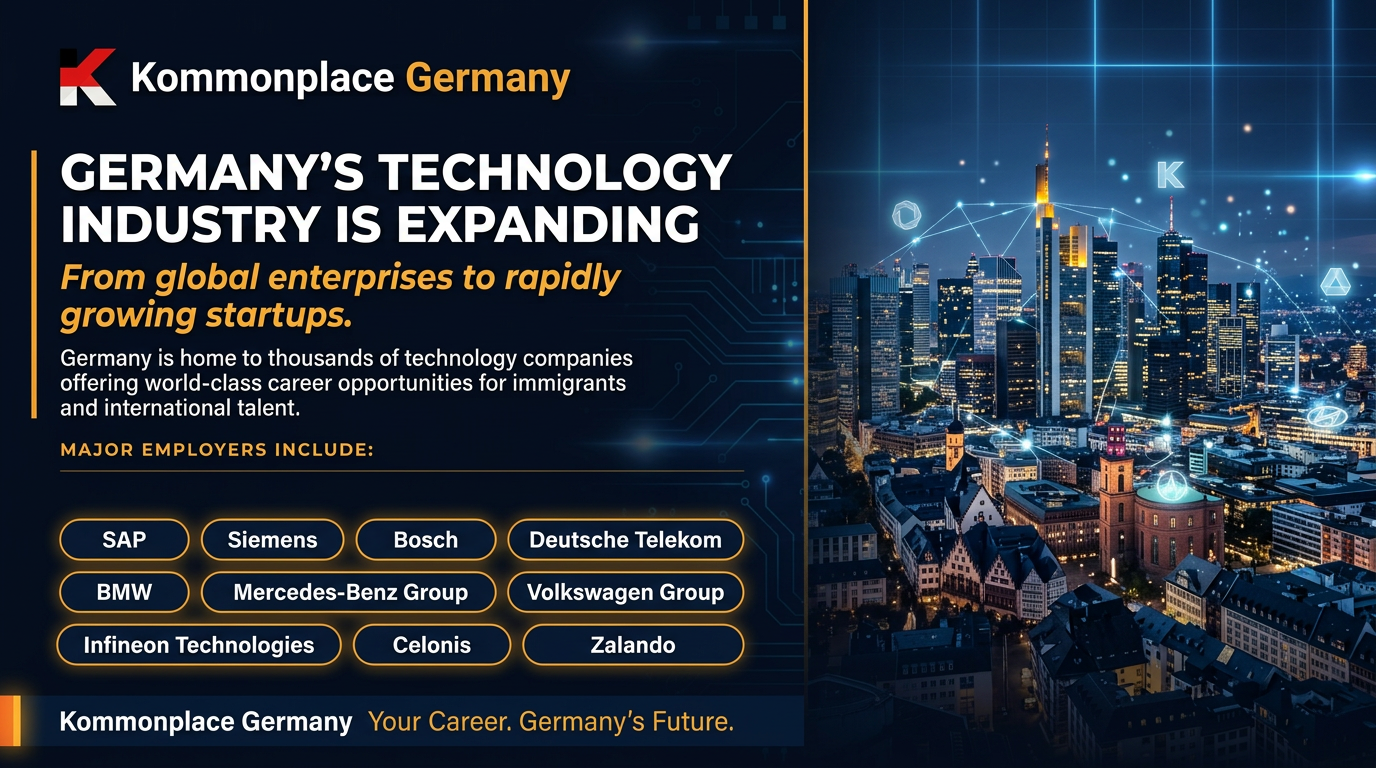
These companies hire internationally across engineering, data, product, design, and business roles. These leading companies actively hire international talent in Germany across engineering, software development, data science, product management, UX/UI design, and business operations. Their growing demand for skilled professionals is creating excellent Germany technology careers for international students and experienced workers alike. Whether you are starting your career or seeking new opportunities, Germany’s expanding technology sector offers competitive salaries, career growth, and long-term employment prospects. Many employers also provide English-speaking roles, making it easier for global professionals to build successful careers in Germany.
Top Career Opportunities in the Germany IT Industry
Major Employers (Examples)
- SAP — enterprise software, cloud, data platforms
- Siemens — industrial automation, digital industries
- Bosch — IoT, mobility, embedded systems
- Deutsche Telekom — telecom, cybersecurity, cloud infrastructure
- BMW / Mercedes-Benz Group / Volkswagen Group — software-defined mobility
- Infineon Technologies — semiconductors, embedded, hardware + software
- Celonis — process mining, enterprise analytics
- Zalando — e-commerce, platform engineering
🔗 Explore more employers in our Jobs & Career Directory
Top Tech Hubs in Germany
Germany is not a one-city tech market. Different cities specialise in different industries.
| City | Known for | Great for roles in |
|---|---|---|
| Berlin | Startups, product companies | Product, frontend, growth, data, design |
| Munich | Deep tech, automotive, research | ML/AI, robotics, embedded, enterprise |
| Hamburg | Media, commerce, logistics | Data, platform, B2C product |
| Frankfurt | Finance, infrastructure | FinTech, security, cloud, compliance |
| Stuttgart | Automotive + manufacturing | Embedded, systems, industrial automation |
| Cologne/Düsseldorf | Media + corporate HQs | Consulting, enterprise IT, analytics |
| Karlsruhe | Engineering + research | Software engineering, cybersecurity |
| Dresden | Semiconductors | Hardware + embedded software |
🔗 Planning relocation? Pair this with our Cost of Living Guide.
High-Demand Roles in Germany (2026 View)
Hiring demand changes over time, but these categories remain consistently strong:
Engineering
- Backend Engineer (Java, Kotlin, Go, Python)
- Frontend Engineer (React, TypeScript)
- Full-Stack Engineer
- Platform Engineer / SRE / DevOps
- Cloud Engineer (AWS, Azure, GCP)
Data & AI
- Data Engineer
- Analytics Engineer
- Machine Learning Engineer
- Applied Data Scientist
- MLOps Engineer
Security
- Security Engineer
- Cloud Security Specialist
- SOC Analyst (for some roles German may be required)
Product & Delivery
- Product Manager (B2B SaaS, mobility, industrial)
- Technical Program Manager
- Scrum Master / Agile Coach
Skills That Get You Hired Faster
Think of your skill set as your “visa-free passport” into the German job market.
| Skill Area | What employers want | Proof that works |
|---|---|---|
| Cloud & DevOps | CI/CD, Kubernetes, IaC | GitHub projects, certs, real deployments |
| Backend systems | APIs, microservices, scalability | System design interviews + projects |
| Data pipelines | ETL/ELT, dbt, Airflow | Portfolio + case studies |
| ML in production | Serving, monitoring, drift | End-to-end ML project + MLOps |
| Security basics | IAM, threat modeling | Practical labs + hands-on experience |
| German language | Bonus for many roles | A2–B1 can significantly expand options |
🔗 If you’re studying in Germany: see English-taught tech programmes.
Powerful Benefits of Working in the Germany IT Industry
- Competitive salaries with exceptional career growth
- English-speaking technology roles
- EU Blue Card eligibility
- Outstanding work-life balance
- Continuous professional development
- Long-term career progression
- Permanent residency opportunities
- Access to Europe’s largest and fastest-growing technology economy
- Opportunities to build successful Germany technology careers
- Exposure to innovative global technology projects
These exclusive advantages make the Germany IT industry one of the best destinations for international professionals seeking secure employment, career advancement, and long-term success in Europe’s thriving digital economy.
Work Visas & Residence Paths for Tech Professionals
Germany offers multiple pathways for international tech talent:
| Pathway | Best for | Notes |
|---|---|---|
| EU Blue Card | Degree holders with qualifying salary | Strong long-term residency pathway |
| Skilled Worker Visa | Qualified professionals | Can work without Blue Card salary threshold |
| Job Seeker Visa | People seeking work from within Germany | Must meet financial + qualification criteria |
| Student → Work | International graduates of German universities | Often the smoothest pathway |
🔗 Need help with paperwork? Read: Visa Application Support — How Kommonplace Germany Helps.
Salary Expectations & Cost of Living Reality Check
Salaries vary by city and company type. Use a “net monthly” lens rather than gross salary alone.
- Munich and Frankfurt: higher salaries, higher rent
- Berlin: slightly lower pay, broad startup market
- Smaller cities: lower pay, but much lower rent
🔗 Use our guide: Cost of Living in Germany for Students (also useful for early-career professionals).
Startups vs. Enterprises: Which Is Better for You?
| Factor | Startups | Enterprises |
|---|---|---|
| Hiring speed | Fast | Slower |
| Role breadth | Wide | Specialized |
| Stability | Lower | Higher |
| Language | Often English | Mixed (often German helpful) |
| Relocation support | Sometimes limited | Often stronger |
| Learning curve | High | Moderate |
Working in the Germany IT industry gives international talent in Germany access to cutting-edge projects, innovative technologies, world-class training, and attractive employee benefits. Whether you are beginning your professional journey or advancing your career, the Germany IT industry provides exceptional opportunities to build successful Germany technology careers with internationally recognized employers.
As the Germany IT industry continues its remarkable expansion in 2026, employers are increasingly looking for software engineers, cloud architects, AI specialists, cybersecurity experts, and data professionals who can contribute to innovation and business growth. This growing demand makes the Germany IT industry one of the strongest employment sectors for international talent in Germany, offering excellent salaries, career stability, and long-term opportunities in one of Europe’s most advanced technology ecosystems.
Common Mistakes International Applicants Make
- Applying without tailoring — Germany rewards relevance
- Ignoring visa timing — start paperwork planning early
- No proof of skills — list impact + projects
- Not learning basic German — even A2 helps massively
- Underestimating housing — start early; bring documents
Frequently Asked Questions
Q: Can I get a tech job in Germany without speaking German? Yes, especially in Berlin, Munich, and internationally oriented companies. But learning German expands your options dramatically.
Q: Do German companies sponsor visas? Yes. Many larger employers are experienced in Blue Card and skilled worker sponsorship.
Q: Is Germany good for junior developers? Yes, but junior hiring is more competitive. Internships, student jobs (Werkstudent roles), and strong projects help.
Q: Which companies hire the most internationals? Large employers and global startups: SAP, Siemens, Deutsche Telekom, Zalando, Celonis, plus many mid-sized SaaS companies.
Conclusion
The Germany IT industry offers outstanding career prospects for international talent. Whether you are planning to study in Germany or looking for a technology career, the Germany IT industry continues to provide excellent salaries, long-term job security, and pathways to permanent residency.
Related Resources on Kommonplace Germany
🔗 Jobs & Career in Germany — Directory 🔗 Visa Application Support — How Kommonplace Germany Helps 🔗 How to Apply for a German Student Visa 🔗 Opening a German Bank Account 🔗 Health Insurance for International Students 🔗 Find Universities in Germany
References & Sources
- Federal Government “Make it in Germany” portal (work + skilled immigration): https://www.make-it-in-germany.com/
- Federal Employment Agency (labour market info): https://www.arbeitsagentur.de/
- Germany Trade & Invest (GTAI): https://www.gtai.de/
- Bitkom (digital association): https://www.bitkom.org/
- EU Blue Card information: https://ec.europa.eu/immigration/
This article is part of Kommonplace Germany — your all-in-one resource for living, studying, and thriving in Germany. For Internationals. By Experience.
Last updated: July 2026